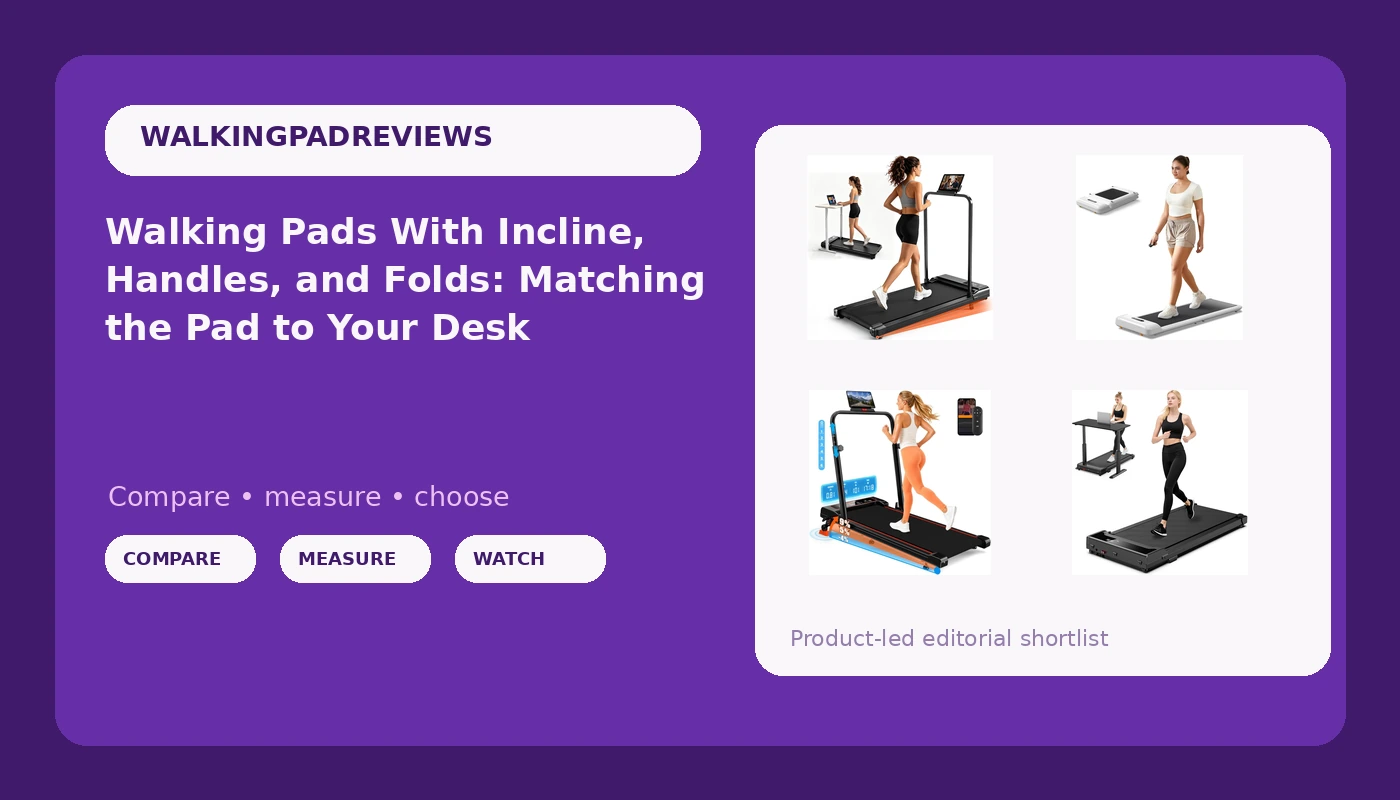
Walking pads look interchangeable in product photos, and they are not. The moment you put a walking pad with incline next to a flat-deck model, three things change at once: the angle of the deck, the load the motor works against, and the way the belt feels under your foot. Add a handle bar, or a frame that folds, and you are no longer comparing variations of one product. You are comparing three different machines that happen to share a footprint.
That matters if you sit for a living. The pad becomes the piece of equipment you touch most and think about least, and the wrong one ends up under the bed by February. This explainer goes through the four pads in this comparison by what they actually are: a slim flat-deck walker, a handle-bar model with incline, a foldable compact unit, and a five-level incline and decline machine. No rankings and no invented numbers, just the differences that decide whether you use the thing or store it.
Related: How Loud Is a Walking Pad at 2 mph? →
Quick answer
The right choice comes down to three questions: flat deck or incline, handle bar or no handle bar, and does the pad have to disappear at the end of the day. A slim flat-deck pad with a wide speed range suits small spaces and low-commitment walking. A model with an incline and a handle bar suits walkers who want more resistance and something to hold. A foldable design suits anyone sharing a room with a bed, a couch, or a dining table. A five-level incline and decline deck suits walkers who want to change the grade during a shift. None of these four is universally better than the others, and none of them is a running treadmill.
4 useful options
| Model | Best fit | What stands out |
|---|---|---|
| Walking Pad Treadmill for Home - Under Desk Walking and Running Portable Electric Machine Adjustable Slim Compact with 0.6-4.0MPH Modes Max up 265 Lbs with Remote Control for Home Office | Small-space desk walking | Listed 0.6 to 4.0 MPH speed range, 265 lb maximum user weight, remote control, slim compact frame |
| Walking Pad Treadmill with Incline and Handle Bar for Home Office | Walkers who want a handhold | Listed incline plus a handle bar in a home-office format |
| WalkingPad C2 Foldable Walking Pad Treadmill, Under Desk Compact Design | Fold-and-store setups | Foldable frame and a compact under-desk footprint |
| Walking Pad Treadmill with Incline 9% & Decline -4% 5 Level and Handle Bar | Grade changes during a shift | Five incline and decline levels spanning a 9% incline to a 4% decline, with a handle bar |
Start here: Walking Pad Treadmill for Home - Under Desk Walking and Running Portable Electric Machine Adjustable Slim Compact with 0.6-4.0MPH Modes Max up 265 Lbs with Remote Control for Home Office
A flat deck is the honest starting point. There is no grade mechanism to fail, no hinge, and no handle bar to catch your hip when you swing a chair around. The trade-off is that flat walking at a fixed speed gets boring faster, and boredom is what kills these machines. The 4.0 MPH top figure is still walking speed for most people, so treat this as a desk pad, not a treadmill. If you already know you want resistance, skip to the incline models below.
The handhold option: Walking Pad Treadmill with Incline and Handle Bar for Home Office
Incline changes the physics in a way that is easy to underestimate. Your body rises slightly with every step, so the same speed costs more effort and the motor works harder. That usually means more noise and more heat, and it is why an incline pad deserves a longer look at the motor and warranty language than a flat one. The handle bar also takes floor space, so measure the depth you have under the desk before you commit to a model with a fixed frame.
The foldable pick: WalkingPad C2 Foldable Walking Pad Treadmill, Under Desk Compact Design
Folding solves a real problem and creates a smaller one: every fold point is a hinge, and hinges are wear parts. The questions worth asking are how many steps the fold takes, whether it needs tools, and how much the unit weighs when you lift it. If you plan to walk twice a day, a pad you fold and unfold twice a day will get more mechanical use than one that stays out. That is not a reason to avoid folding, it is a reason to think about it honestly before buying.
The grade changer: Walking Pad Treadmill with Incline 9% & Decline -4% 5 Level and Handle Bar
A 9% incline is steep for a walking pad, and a 4% decline is mild but genuinely different. Walking downhill shifts load toward the front of the leg and asks more of the ankle, so the decline setting is something to introduce gradually rather than to start a first session with. It is also the pad in this group where the remote matters most, because if you change grade during a workday you will change it often, and you want that control within reach of your typing hand.
Prices and availability may change. Product images, names, and retailer links are matched to verified listings. No current price, rating, stock status, or measured result is stated here without current evidence.
What incline actually changes
On a walking pad, incline is usually a lift at the front of the deck rather than the heavy motorized mechanism you would find on a gym treadmill. Even so, raising the front end changes several things at once. Your hip flexors work through a slightly longer range, your calves take more load, and your cadence tends to drop unless you consciously hold it. Because each step lifts your body weight a little, the motor draws more current at the same belt speed, which is the point where cheap pads start to sound strained.
Incline also changes where your foot lands. On a flat deck you can let your stride fall naturally. On a raised deck, your foot tends to land closer to the front of the belt, and on a short deck that eats into the room you have for a normal stride. This is why deck length deserves a tape measure, not a glance at the product photo. If your natural walking stride is long, a compact deck with a steep incline will feel cramped before it feels hard.
Finally, grade changes are not free. Every level change is a mechanical event, and on a pad that runs under a desk, you will hear it and feel it through the deck. A five-level machine gives you more ways to vary a long workday, and more parts that move. That is the trade in one sentence.
Handle bars, folding frames, and the remote
A handle bar is a stability feature, not a training feature. It gives you something to grip while you find your balance at the start of a session, and it gives you a reference point when you step off. It also occupies floor space in front of the desk and can interfere with a chair you roll in and out all day. If you have never walked on a moving belt, a handle bar shortens the learning curve. If you have, it is optional.
Folding frames solve storage, and storage is the most underrated spec in this category. The realistic failure mode for a walking pad is not a burned-out motor, it is a pad that stays folded because setting it up is annoying. A fold that takes two motions and no tools gets used. A fold that requires clearing the floor, kneeling, and lifting a heavy deck does not.
The remote deserves the same scrutiny. It is the control you touch dozens of times a day, so its battery type, its range, and whether it needs a clear line of sight to the deck all matter more than the top speed printed on the box. Check that the pad also has controls on the machine itself, because a lost remote should not turn a walking pad into a very expensive footrest.
- Measure the space under your desk, including the depth a handle bar would add, before comparing anything else.
- Compare your body weight, with shoes and whatever you carry, against the listed maximum user weight on each model.
- Decide flat deck or incline first, because that single choice removes half the field.
- Decide whether you need a handhold, and whether you have the floor space to give up for it.
- Decide whether the pad must fold, and how many times a day you are honestly willing to fold it.
Practical guidance
- Start every session at the lowest speed for the first week, then raise it once your stride feels automatic.
- Keep the remote where your hand already rests, not on the far corner of the desk.
- Walk in flat, thin-soled shoes on an incline and barefoot or in socks on a flat deck, whichever keeps your feet relaxed.
- Set an hourly step target rather than a daily one, because the point of a desk pad is spreading movement across the day.
- Check belt tracking and tension monthly, and stop using the pad if the belt drifts to one side while you walk.
Which option should you choose?
Choose the Walking Pad Treadmill for Home - Under Desk Walking and Running Portable Electric Machine Adjustable Slim Compact with 0.6-4.0MPH Modes Max up 265 Lbs with Remote Control for Home Office when you want a flat deck, a wide speed range, and the simplest possible machine for a small space. Choose the Walking Pad Treadmill with Incline and Handle Bar for Home Office when you want resistance and a handhold without managing five levels. Choose the WalkingPad C2 Foldable Walking Pad Treadmill, Under Desk Compact Design when the pad has to fold and store between sessions. Choose the Walking Pad Treadmill with Incline 9% & Decline -4% 5 Level and Handle Bar when you want to change grade in both directions across a long workday.
The caveat is the same for all four: these are walking machines with listed speed ranges and weight limits, and the listings are the only evidence available here. Deck length, belt width, and real noise at walking speed are the specs that decide daily comfort, and they are the specs most often missing from a product page. Measure your space, check the weight limit, and read the warranty terms before you decide.
The bottom line
There is no single pad here that wins for everyone, and anyone who tells you otherwise is selling something. The flat-deck model wins on simplicity and space. The handle-bar model wins on stability and added resistance. The foldable model wins on storage, which is the feature that keeps a pad in use rather than in a closet. The five-level incline and decline model wins on variety for long shifts. Match the machine to your room, your stride, and your honest willingness to set it up, and the pad will still be under your desk in six months.