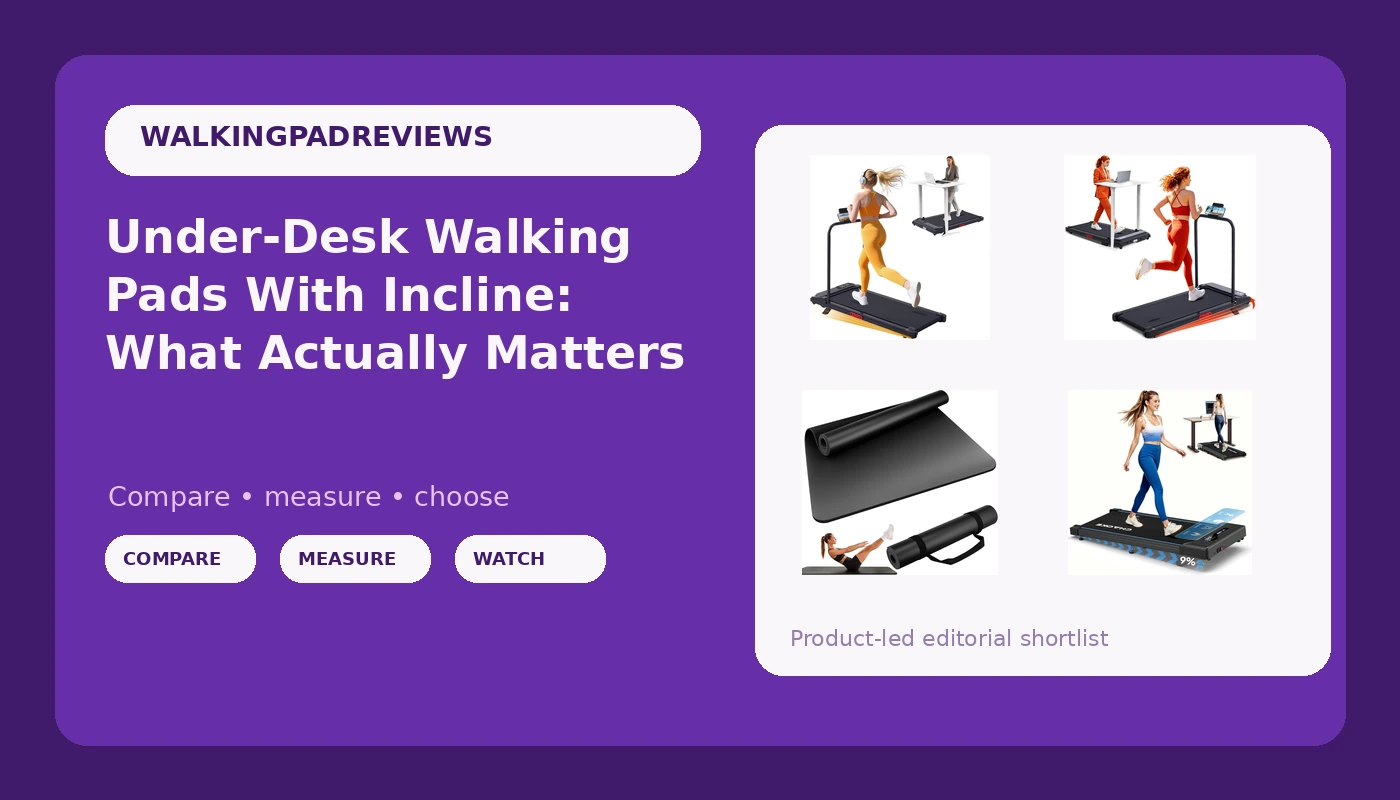
An under desk walking pad with incline is an odd purchase. It gets sold beside running machines, reviewed beside standing desks, and bought mostly by people who want to stop sitting for ten hours a day. The specs that get shouted the loudest, peak horsepower and top speed, rarely decide whether the thing is still pleasant to use in month three.
This guide covers four verified listings that span a realistic shortlist: two walking pads with an incline and a handle bar, one compact portable pad with a handle bar, and one non-slip exercise mat for the floor work that goes with them. No prices, no star ratings, no invented test results. Just what each listing states, what it means for a desk setup, and which one fits which room.
Related: How to Set Up a Walking Pad Under a Standing Desk →
Quick answer
For a standing desk and long, steady walking sessions, the CHAOKE Walking Pad Treadmill is aimed at that job: a 9% incline, a 2.75HP motor, a 6.2MPH top speed, a 330 lb capacity, and 12 preset HIIT programs. For a pad you can also use away from the desk, with a handle bar for balance and a wider pace range, the KASSADIN pad covers more ground. The compact portable pad is the smallest and simplest option in this group, and the yoga mat is the accessory that makes the floor beside your desk usable between sessions.
Four useful options
| Model | Best fit | What stands out |
|---|---|---|
| CHAOKE Walking Pad Treadmill | Incline walking at a standing desk | 9% incline, 2.75HP motor, 6.2MPH top speed, 330 lb capacity, 12 preset HIIT programs |
| KASSADIN Electric Walking Pad Treadmill | Balance support and a wider pace range | Handle bar, incline, 3.0HP motor, 0.6 to 7.6MPH range, 350 lb capacity |
| Portable Treadmills for Home Compact Walking Pad | Very small rooms and simple sessions | Compact frame with a handle bar and an incline |
| Professional PU & Natural Rubber Yoga Mat | Stretching and floor work beside the desk | 5mm thick, 72 by 27 inch surface, non-slip PU and natural rubber, strap included |
Desk-first incline pad: CHAOKE Walking Pad Treadmill
The trade-off with an incline and no handle bar is stability confidence. A raised front end means your feet land slightly downhill, and if you are new to walking while typing, the first week can feel less secure than a flat deck. That is a fit question, not a defect. If you know you want to hold something, look at the two handle-bar pads below. Also budget for desk clearance: a deck that rises at the front needs more room under the desktop, so measure before you buy.
Balance-first walker: KASSADIN Electric Walking Pad Treadmill
A handle bar is the feature that decides where the pad can live. Under a fixed-height desk, a bar is often in the way; in an open corner or in front of a TV, it is the reason you will actually use the machine on days you feel unsteady. Treat the two use cases as different products. If you want one pad for both, check whether the bar folds or detaches, and how much floor space the folded position takes.
Compact option: Portable Treadmills for Home Compact Walking Pad
The honest caveat here is information. A shorter listing leaves more questions open: belt width, deck height, motor type, warranty length, and what happens at 2.5MPH when the frame is at its lightest. None of those are reasons to skip it, but they are reasons to read the current listing page carefully and check the return window before committing. If your space is the binding constraint, this is the category that solves it.
Floor companion: Professional PU & Natural Rubber Yoga Mat
This is the only item in the group that is not a machine, and that is the point. A mat gives you a defined place to do hip flexor and calf work after a long walk, and a 27 inch width is wide enough for mat Pilates without feeling cramped. If you already own a mat you like, skip it. If your "home gym" is 12 square feet of living room floor, it is the cheapest way to make that floor useful.
Prices and availability may change. Product images, names, and retailer links are matched to verified listings. No current price, rating, stock status, or measured result is stated here without current evidence.
Why an incline and a handle bar change the decision
An incline raises the front of the deck, which means your body is working against gravity even at a slow pace. The practical effect is that 2MPH on a 9% incline feels like more work than 2MPH flat, so you get more effort out of a speed that still lets you type. The cost is geometry. A raised deck sits taller at the front, eats into the space under your desk, and changes how your feet land. If you wear barefoot or minimal shoes, the downhill landing is the part to think about first.
A handle bar solves a different problem. It gives you something to touch when you look up at a monitor, reach for a mouse, or turn to answer a question, and it makes the pad usable in a corner where no desk is involved. It also takes up space and can block a keyboard tray, a drawer, or the walking path into the room. The pads here split cleanly on this line: one incline deck built for desk use, and two with handle bars for balance.
How to read a walking pad listing before you buy
Peak horsepower and sustained horsepower are not the same number, and listings rarely separate them. What matters at walking speed is whether the motor holds a steady pace without surging, which is why a higher claimed figure is not automatically better. Top speed deserves the same skepticism: 6.2MPH and 7.6MPH are running numbers on a machine you will use at 1.5 to 3MPH, so treat them as headroom, not a feature you will use.
The features that actually shape daily use are the boring ones. Belt width decides whether your stride fits. Deck height decides whether the pad slides under your desk. The remote decides how often you change speed, and a remote that needs a clear line of sight or a fresh battery is the failure point most listings never mention. Warranty length is the other tell, because a company that trusts its motor backs it for years.
- Measure the gap under your desk with the desk at standing height, then compare it to the deck height you need.
- Decide whether you want a handle bar before you compare anything else, since it changes where the pad can live.
- Check the stated speed range and pick the pad whose low end is below your normal walking pace.
- Confirm the listed capacity clears your body weight with margin, not by a pound or two.
- Read the current listing page for belt width, warranty terms, and return window, because those details change.
Practical guidance for a small home office
- Put the pad where you will see it. A pad stored behind a door gets used eleven times and then lives under the bed.
- Set the desk first, then the pad. Standing height plus deck height plus incline is the number that decides comfort.
- Walk in the shoes you will actually wear. Barefoot changes your cadence and your foot strike on a downhill deck.
- Keep the remote within arm's reach and check its battery monthly, since that is the part that fails first.
- Add ten minutes of floor work after your last walk. The mat in this group exists for exactly that, and it is the half of the routine that protects your hips and calves.
Which option should you choose?
Choose the CHAOKE Walking Pad Treadmill when the pad lives under a standing desk and you want incline effort at typing speed without a bar in the way. Choose the KASSADIN Electric Walking Pad Treadmill when you want a handle bar for balance and a speed range that stretches beyond desk walking. Choose the Portable Treadmills for Home Compact Walking Pad when floor space is the constraint and you are comfortable confirming the details yourself. Choose the Professional PU & Natural Rubber Yoga Mat when you already have your machine and need a dedicated surface for stretching and floor work.
One caveat applies to all four: these listings describe products, not your room. Deck height, belt width, noise at walking speed, and warranty terms are the details that decide whether a pad works for you, and they are the details a listing page can change without notice. Verify them on the current page before you buy, and keep the return window in mind.
The bottom line
An under desk walking pad with incline is a tool for adding movement to a day that would otherwise be eight hours of sitting, and the four listings here cover the realistic shapes that tool takes: an incline deck for the desk, a handle-bar pad for balance and range, a compact pad for small rooms, and a mat for the floor work that finishes the job. Match the pad to the space and the routine first, confirm the numbers on the listing page second, and the machine you buy will be one you keep using rather than one you store.