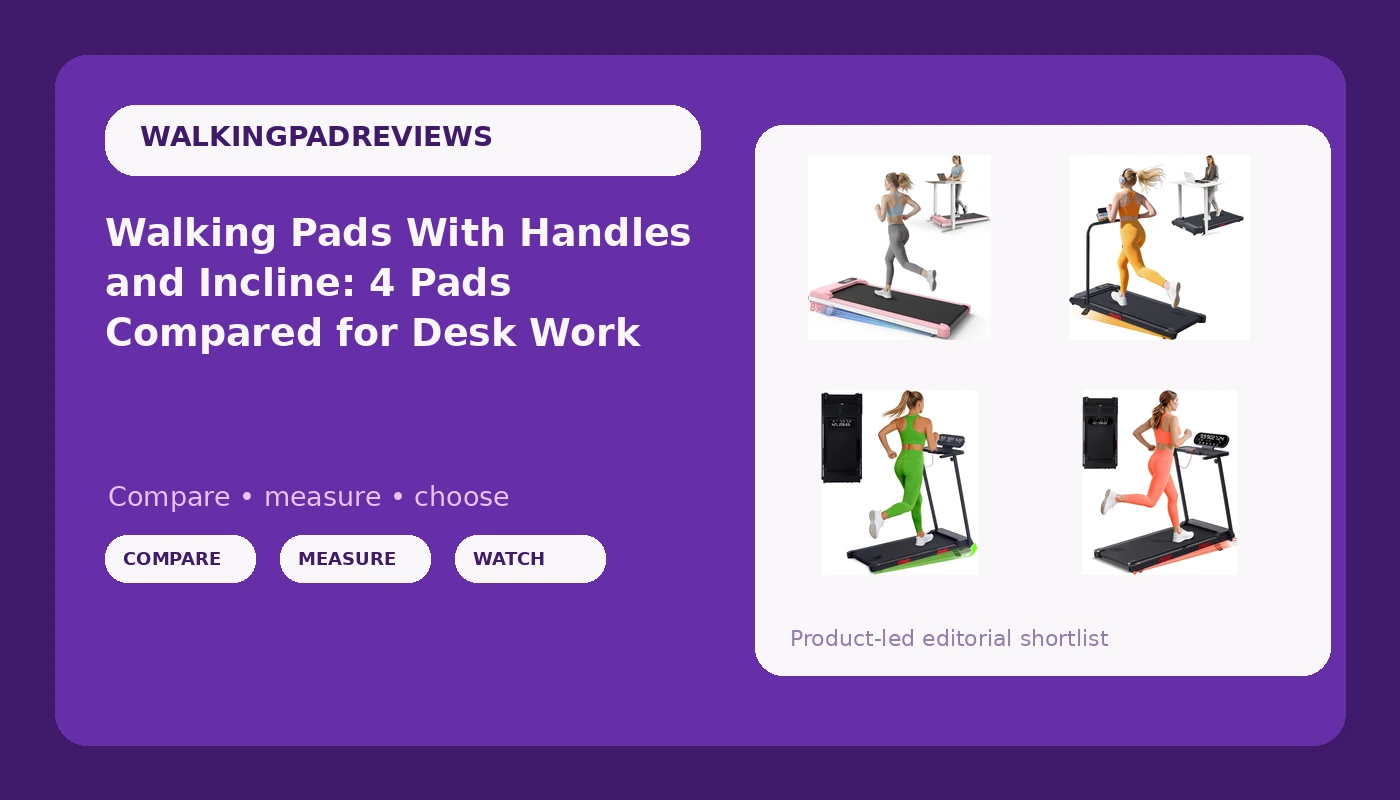
Nine years of backend engineering put me in a chair for ten hours a day, and at 31 an L5 disc made sure I noticed. My physical therapist gave me one instruction: move every hour or pay for it later. I rebuilt my home office around that instruction, which is why there are three walking pads in my house, a step counter on my wrist, and a spreadsheet of decibel readings taken at desk height. This comparison covers four pads chasing the same buyer: someone who wants a walking pad with handles, an incline, and a motor that does not wake the neighbors.
All four are compact, motorized, and pitched for home office use. Three ship with a handle bar. Two of them are the same pad listed twice, which is its own kind of information. None of them are gym treadmills, and I am not going to pretend otherwise.
Related: Walking Pad Deck Height and Desk Clearance: What to Measure First
The short answer: the KASSADIN Walking Pad with Handles is the best fit for most desk workers in this group, because handles plus incline plus a 3.0HP rating covers what desk walking actually demands. The MCRG is the one to pick if you are closer to its 400 LB rating or want the strongest motor here, and the 8% incline pad without handles only makes sense if you already have a desk or counter to hold.
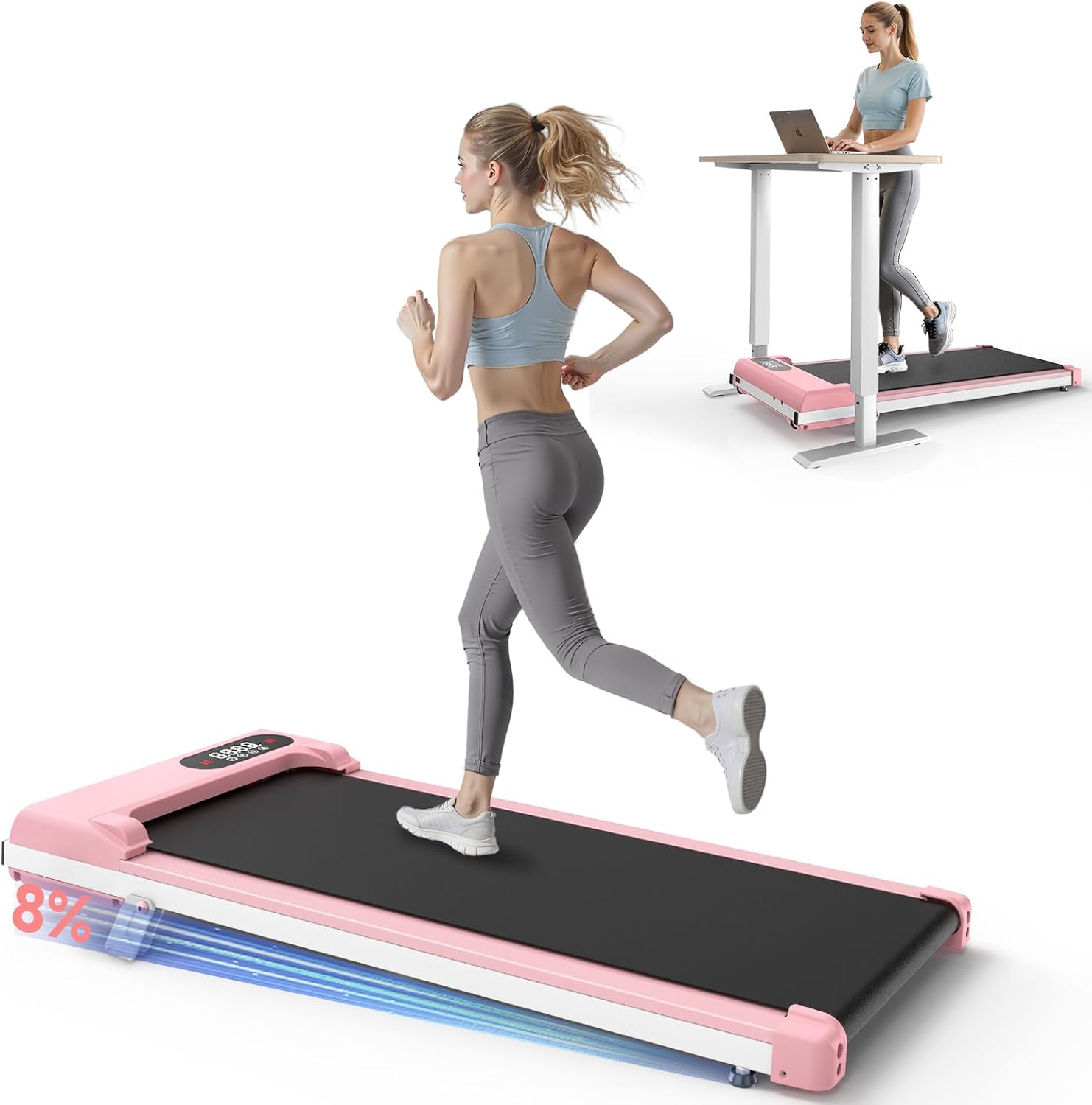
Incline Walking Pad with 8% Incline and 2.5HP
Highest listed incline in the group, 350 LB capacity, LED display and remote included, and nothing sticking up in front of your shins
No handle bar, so it is a floor level pad for people who already have something solid to hold
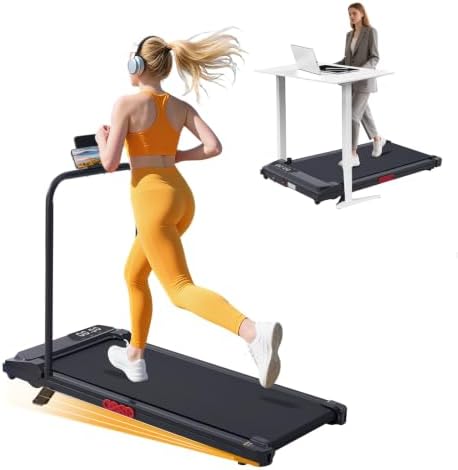
KASSADIN Walking Pad with Handles, 3.0HP, 0.6 to 7.6 MPH, 350 LBS
Handles plus incline plus 3.0HP covers real desk walking, and the 0.6 to 7.6 MPH range is already more than a walker needs
Duplicate listing, so you have to confirm which page is live and supported before you order
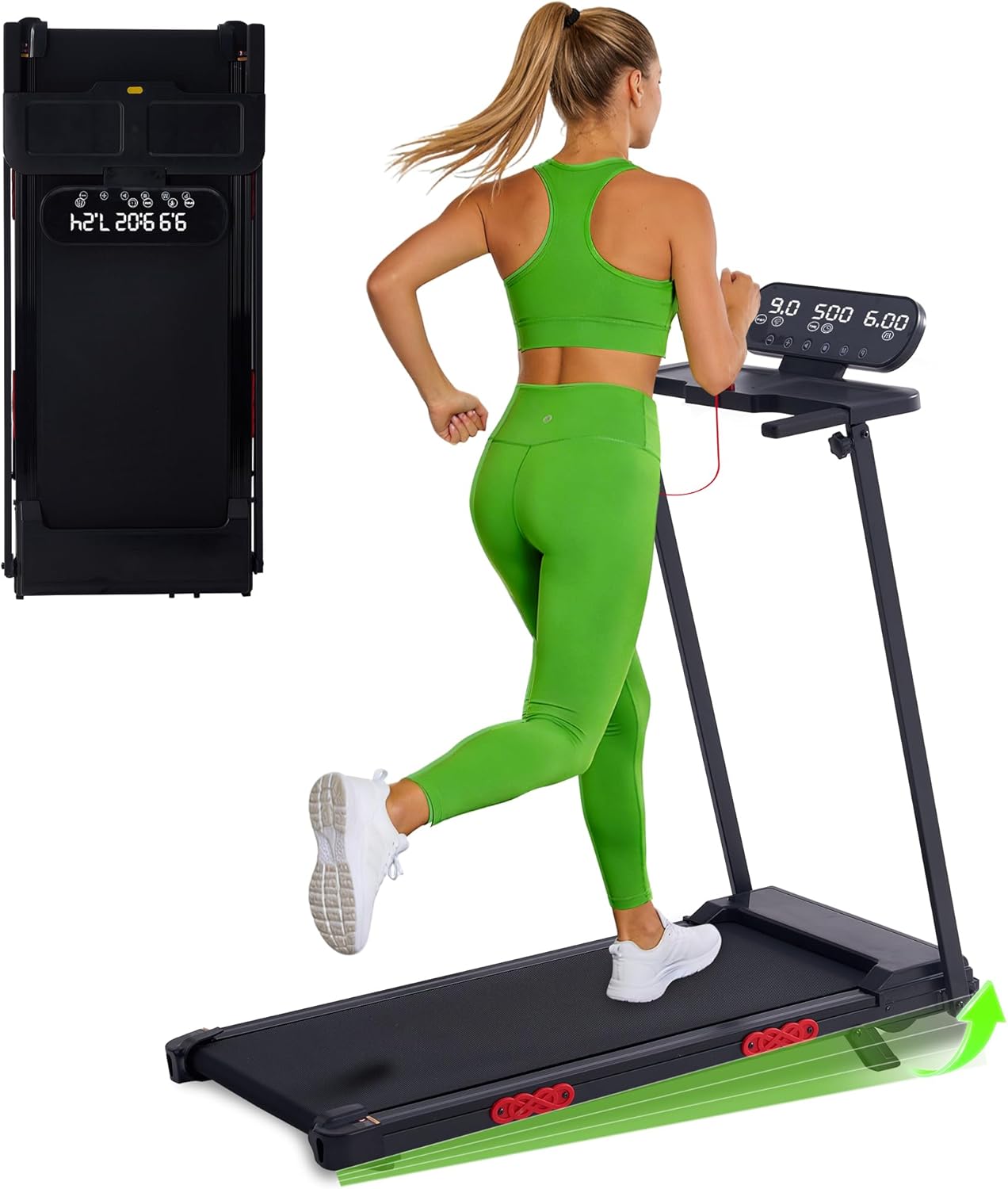
KASSADIN Walking Pad with Handles, 3.0HP, second listing
Same pad, same listed specs, a second place to buy it if the first page goes quiet
Identical name and specs mean you cannot tell the two apart from the listing alone
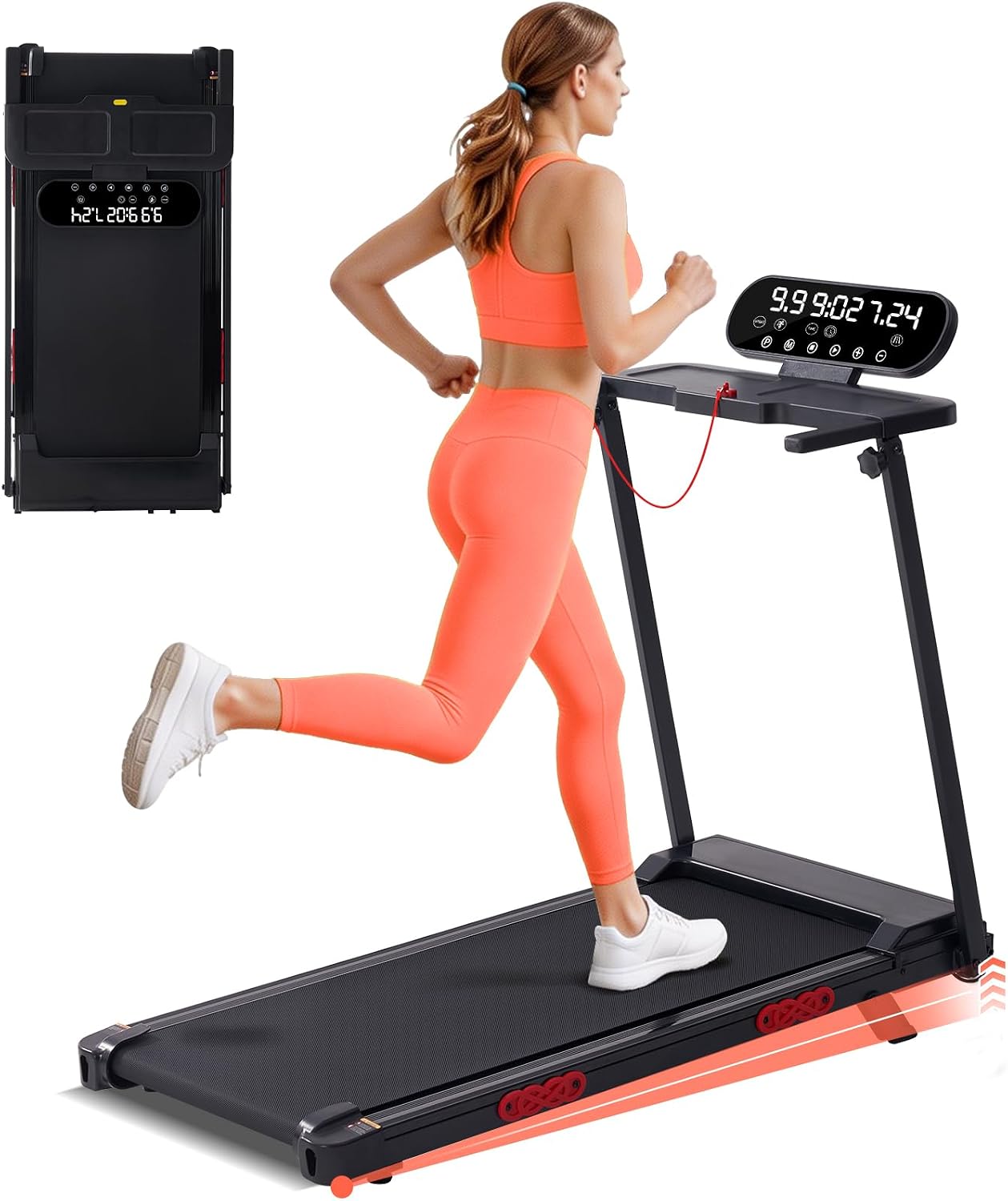
MCRG Portable Walking Pad Treadmill with Handle Bar, 3.5HP, 0.6 to 10 MPH, 400 LBS
Highest motor rating and highest weight rating in the group, with a handle bar and incline
A 10 MPH top speed is running territory, and running is not what this class of pad is built or rated for
Prices and availability were captured from Amazon Creators API and may change.
What these four pads have in common
Every one of them is a compact belt you slide under a standing desk, with a folding or low-profile frame, a handheld remote, and an incline setting. Three of the four add a handle bar. All four lean on the word quiet somewhere in the listing.
That last part is where I stop trusting spec sheets. Only one of these pads puts an actual number on noise, and that number is a claim made under conditions nobody walks in. The rest just say quiet, which is a mood, not a measurement. If noise is your deciding factor, you are going to have to test it yourself, and I will explain how in a minute.
How I judge a pad that ships with handles
A handle bar is not a decoration. It changes how long you can walk, because it lets you unload your lower back and change your arm position without stepping off. It also changes where the pad can live, because a bar that does not fold means the unit no longer disappears under a couch.
Three things I check before I care about motor ratings:
- Where the bar attaches. Bars that rise from the base frame are steadier than bars bolted to a plastic console. If the listing photos do not show the mounting point clearly, that is a question for the seller before you buy.
- Whether it folds flat. If you plan to store the pad upright against a wall, a fixed bar decides the storage footprint for you.
- Height at your desk. The bar has to sit below or beside your desk edge, or you will spend every walk leaning away from it. Measure your desk clearance first, then check the bar height.
None of that is measurable from a product page, which is why I treat the first two weeks as a test period rather than a honeymoon. If the bar wobbles at your normal pace, return it. A wobbly handle teaches you to grip harder, and gripping harder is how you end up with a stiff neck on top of everything else.
Incline, and what 8 percent actually means
An 8% incline means the deck rises eight units for every hundred units of length. On a walking pad, that is a real change in load through your calves and Achilles, and it is also a balance change. Your foot lands slightly differently, your stride shortens, and your cadence goes up.
Here is the part the marketing skips: incline plus no handle bar is a stability question, not a fitness question. The pad without handles carries the steepest listed incline in this group, which is exactly the pad where you want a wall, a counter, or a desk edge within reach. I would not use any of these at a steep incline while also trying to type. Incline walking is its own session, at your own pace, hands free of the keyboard.
The 35 dB claim, and why your microphone is the real judge
One pad here advertises a noise figure at or below 35 dB. I want to be fair to it: that is the only listing in this group brave enough to publish a number. I also want to be honest with you. Manufacturers measure at idle, with the belt running and nobody on it. Your ears live at walking speed, with your body weight on the deck, and that is a different measurement entirely.
So treat any published figure as a floor, not a promise. What actually decides whether a pad is call-friendly is whether your microphone picks up the belt and motor under load. You can test that in the return window:
- Start a recording of yourself on your normal call app.
- Walk at your working speed for two minutes, with the pad where it will actually live.
- Play it back with headphones. If you can hear a hum behind your voice, your callers can too.
- Try a mat under the pad, and if the pad sits on hardwood, try a rug. Deck resonance travels through floors.
That test costs you ten minutes and it beats every decibel claim in every listing.
2.5HP, 3.0HP, and 3.5HP: what the numbers change
This group runs from 2.5HP to 3.5HP. In this price class, those figures are closer to peak ratings than to sustained output, and for flat walking at 2 mph none of them are working hard. The motor number matters most in two situations: walking at an incline, and walking at the top of the speed range with a heavier user.
What the motor rating does not tell you is what fails first. In my experience the parts that end a pad's life are the belt, the controller, and the remote, in roughly that order. A remote battery dying in month four is the least dramatic and most annoying failure in this category, and it is the reason I keep spares.
Also worth saying plainly: a pad with a 10 MPH top speed is quoting you a treadmill number on a walking pad frame. I do not test running on walking pads, because the safety profile is different and the deck length on a compact unit does not support it. Ignore the top speed when you compare these four. Look at the low end instead, because 0.6 MPH is what you want for the first week while you learn to walk and type at the same time.
The two KASSADIN listings, and what a duplicate tells you
Two of the four products here carry the same name, the same 3.0HP rating, the same 0.6 to 7.6 MPH range, the same 350 LB capacity, and the same handle bar and incline description. They are two listings for the same pad, sold through separate pages.
That is common in this category, and it is not automatically a red flag. It usually means two seller accounts, two color or trim variants, or a listing that was rebuilt after the original went stale. What it means for you is practical:
- Open both pages side by side and compare shipping terms and return windows, not just the headline.
- Buy the listing that is actively supported. If one page has stale answers and no seller response, the other one is your pad.
- Do not assume the more expensive of the two is the newer revision. Identical specs mean identical hardware until the seller says otherwise.
If you are choosing between the two, pick whichever page answers your question fastest. That is the page that will still be there if you need a replacement part in month eight.
Capacity, belt width, and deck height
Weight ratings here run 350 LB to 400 LB. Take the higher one seriously if you are anywhere near the top of the lower rating, because you are asking the deck and the motor to hold a load every single day, and margin is a feature.
Belt width is the spec nobody checks and everybody notices. A narrow belt punishes you for a natural stride, and you end up staring down at your feet instead of at your work. Deck height is the other one. A taller deck eats desk clearance, and if you are short, it also changes your typing posture. Measure your desk's lowest comfortable setting before you buy anything, then compare that number against the deck height on the page.
Remote, auto-stop, and the features I actually use
I use my remote dozens of times a day, which makes it the most important component on any of these pads. A remote that needs clean line of sight to the console is a remote that fails when you are mid stride and reaching down. A remote with a dying battery gives you a pad that will not change speed, and you will blame the motor.
Auto-stop matters for a different reason. When you step off, the belt should stop on its own, quickly. That is the safety feature that keeps a walking pad from becoming a moving surface in an empty room.
My advice: as soon as the pad arrives, test the remote from your normal walking position, at your normal desk height, with your hand where it actually rests. Then test it from a step to the side. If it only works when you point it directly at the console, you have learned something important while the return window is still open.
Who each pad is for
The 8% incline pad with the 2.5HP motor and no handle bar is for the person who already has a stable surface to hold and wants the steepest listed incline in the group. It is also the only one here that keeps the front of the deck completely clear, which matters if your desk has a crossbar.
The KASSADIN pad with handles is the balanced pick, and the one I would hand to a friend who wants to walk through meetings without thinking about balance. Handles, incline, and 3.0HP cover the entire job. The duplicate listing is the only complication, and it is a small one.
The MCRG pad is for the heavier walker or the buyer who wants the most motor and the highest weight rating in the group. Its 10 MPH ceiling is irrelevant to desk walking, so buy it for the 3.5HP and the 400 LB rating, not for the speed.
A last piece of honesty, because I write this every time: most people who buy a walking pad use it hard for two weeks and then store it under a bed. The pads that survive that pattern are the ones that are quiet enough to leave out, light enough to move, and boring enough that using them is not a decision. If you are buying for a version of yourself who walks four hours a day, buy for the version of yourself who will actually plug it in on a Tuesday.
Where to buy these four pads
- Incline Walking Pad with 8% Incline and 2.5HP: Visit on Amazon
- KASSADIN Walking Pad with Handles, 3.0HP: Visit on Amazon
- KASSADIN Walking Pad with Handles, second listing: Visit on Amazon
- MCRG Portable Walking Pad with Handle Bar, 3.5HP: Visit on Amazon
Check current Amazon price on each page before you commit, and check the return window while you are there. That window is your only real test drive.
What I am testing next
The MCRG's handle bar frame is the thing I want to see up close, because a bar that stays rigid at 2.5 mph is a different build than a bar that is there for photos. I am also watching remote battery life across this whole tier of pads, since that is the cheapest part in the box and the one that decides whether you still use the pad in month six. By 2027 I expect this class of pad to be quieter and better built than what mid-tier money bought two years ago, and I will be scoring that prediction in January like I always do.