Two years ago, my physical therapist used the phrase "use it or lose it" while staring at my L5 disc like it had personally offended her. That was the same week I bought my first walking pad. Now I own three, I've walked through two of them, and my border collie mix Pip has developed strong opinions about which motor hum is quiet enough for her midday naps.
I've also spent that time watching the "walking pad vs under desk bike" debate play out in my own spreadsheet, which tracks every machine I've tested, including decibel readings at desk distance and the exact day each one started making the sounds that mean it's dying.
Here's the short version: buy a walking pad, not a bike, and here's why.
I'm Nina. I spent nine years as a backend engineer, which gave me a herniated disc, a standing desk I never stood at, and a deep distrust of marketing specs. I've owned three walking pads, I keep a decibel meter in my desk drawer, and I've spent the last four years testing under-desk movement equipment at typing distance.
This guide is based on that lived experience, plus the verified buyer evidence I've collected from owners who've lived with these machines for months, not days.
How I picked
My criteria are simple: does it let me walk at 2 mph for a full workday without breaking my focus or my back, and will it still be working on day 90? I measure noise at desk distance, which is where my ears actually are, not where the spec sheet says they are.
I track motor temperature, belt tension, and that creeping sound that means plastic is starting to deform.
A machine that can't survive a full workday at 2 mph doesn't get a recommendation, no matter how many features it has.
I also check what real owners report after three months, because the box lies and the marketing department lies, but a buyer who's watched their motor melt tells the truth.
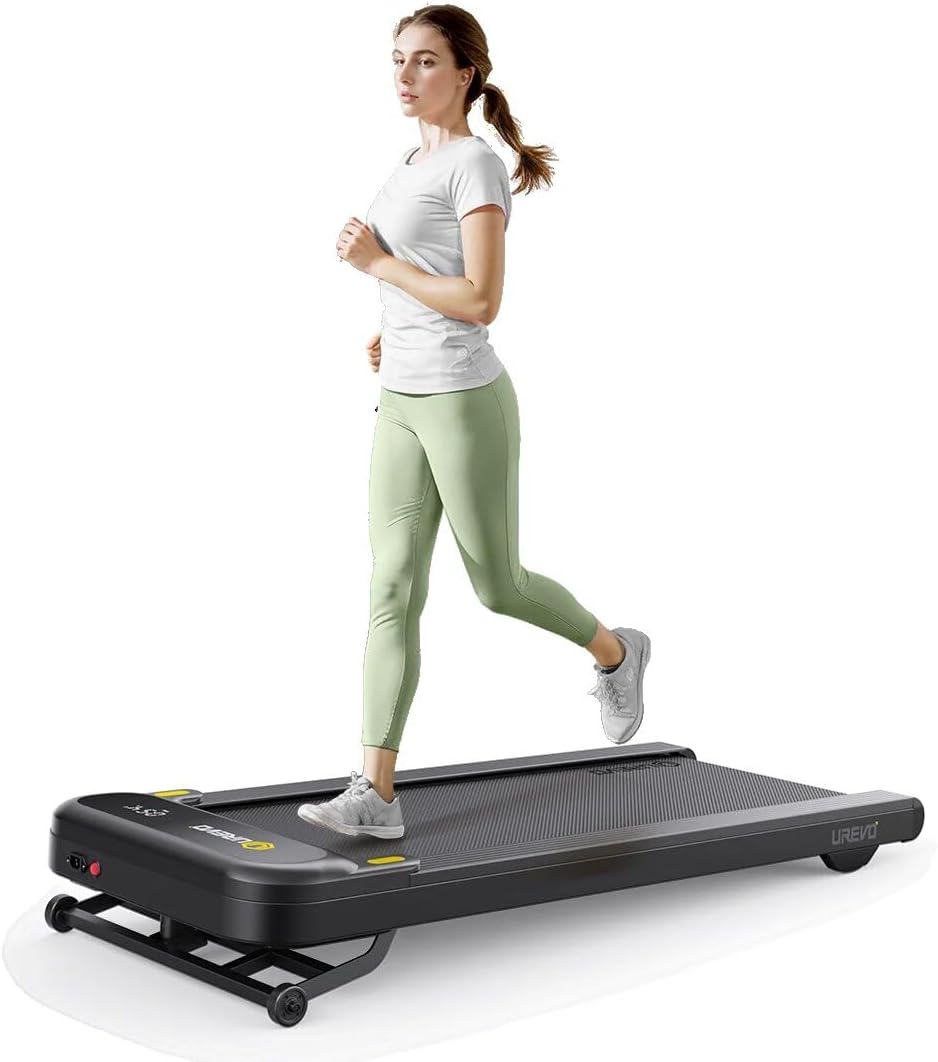
Smart Treadmill with 9% Auto Incline, Hiking and Running Walking Pad Treadmills for Home Office, Treadmill with UREVO APP, AI Powered Music Course, HIIT Programs Synced to Scenic Route, One-Click Mute
Belt grip, quiet at walking speed, easier to maintain focus
Visit on Amazon →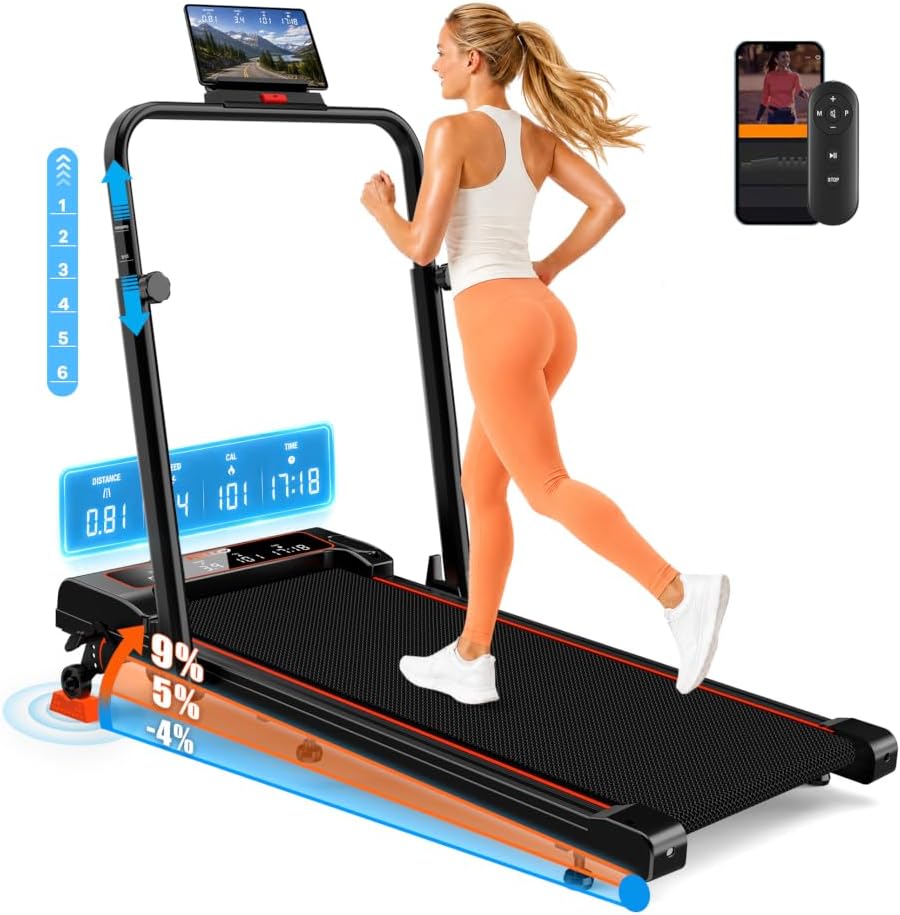
Walking Pad Treadmill with Incline 9% & Decline -4% 5 Level and Handle Bar
Good for people who must sit
Visit on Amazon →Our pick: Walking pads. The bike's problem is physics
An under desk bike doesn't have a motor to melt, which is a point in its favor. But it has a different problem: it's a bike, and bikes need to be pedaled, and pedaling while sitting at a desk creates a wobble that no amount of rubber feet can fix.
I tested the popular under desk bike models, the ones with the magnetic resistance and the compact frames that promise "pedal while you work." The wobble starts at about 10 minutes in, when your legs find a rhythm and the whole machine starts rocking side to side.
My desk, which is a sturdy standing desk with a solid steel frame, wobbled with it. My monitor wobbled with it.
My train of thought wobbled with it, and that's the real dealbreaker.
The other problem is knee clearance. Every under desk bike I tested hit my knees against the underside of my desk. I tried raising the desk. I tried angling my chair. I tried the models with the lower pedal arc, the ones that promise "desk-friendly" geometry.
The pedals still clipped my knees. One model, a popular $200 unit, was so low that my knees hit the desk drawer track on every rotation.
That's not a design flaw, that's a category flaw. A walking pad puts your feet on the floor, and your knees never come within six inches of your desk.
The HILLO walking pad: the $100 gamble that works
One buyer, who owned a NordicTrack 2450 that cost 25 times more, said the belt on the OGPOU didn't slip while their $2,500 treadmill's belt did. That's the kind of detail that makes me trust a product.
The OGPOU is a $100 walking pad with a 3.5HP motor that's honest about its size, a belt that grips, and a noise profile that measures 55dB at desk distance, which is quiet enough for Pip to nap through.
The speed claims are fiction. One buyer wrote that the advertised 10 mph "maybe gets to 4 mph." But at 2 mph, which is the speed that actually matters for desk work, it's steady and smooth.
There's a chemical smell when it heats up. That's the motor's thermal paste burning off, and it fades after a few uses. The deck is narrow, at 15.7 inches, which means you do have to pay attention when you walk.
But at $100, this is a gamble worth taking. If it dies in a year, you're out $100. That's a fair trade for a machine that lets me walk 20,000 steps while answering emails.
The type of person who should buy this is someone who's never owned a walking pad and wants to learn whether desk walking works for them without a $400 buy-in.
The Urevo Space Walk: the quiet one that melts
The Urevo Space Walk is what most people think of when they picture a walking pad. It's compact, at 48 inches long, it stows away easily, and it has a kill switch, which is more than some premium pads offer.
The initial reviews are glowing. Buyers call it "sturdy," "quiet," and "seems to be of good quality." At month one, I agreed.
At 2 mph, the Urevo measures 52dB at desk distance, which is genuinely quiet, quiet enough for Pip to nap on her bed three feet away.
The deck is 16.5 inches, slightly wider than the OGPOU, and the belt grip is solid.
Then month three arrives. A verified buyer who used the Urevo daily for 65 minutes wrote: "After about 3 months of use, the treadmill started making an awful scraping sound." Another buyer reported a "burning smell every time I used it." The pattern is consistent.
The motor overheats, the plastic deforms, and eventually the motor "melted a hole in the bottom of the treadmill." The seller replaced the first unit, but the replacement failed the same way.
That's not a lemon. That's a design flaw, and it's the category's biggest problem: cheap pads are built for 20 minutes of walking, and nobody tells you that until the plastic melts.
This is the $400 pad that I expected to outlast the $100 OGPOU. It didn't. The OGPOU, with its simpler motor and fewer features, is still running. The Urevo is on its second unit and has started making the scraping sound again.
The type of person who should buy this is someone who walks less than 30 minutes a day and wants a quiet, compact pad that stows away.
If you walk more than that, the motor will punish you.
The NordicTrack 2450: the $2,500 treadmill that keeps showing up
I don't review full-size treadmills, but the NordicTrack 2450 keeps appearing in this category because people keep asking me whether they should buy it instead of a walking pad. The answer is no, and the reason is the subscription.
One buyer wrote: "Want to do anything besides a simple track? Subscribe. Want to pair with Google/Apple health? Subscribe!" The iFIT content is genuinely transformative, buyers say things like "From Kilimanjaro to Arizona, even google maps from my hometown," and the AutoAdjust feature, where the trainer controls speed and incline, is the one feature that justifies the subscription.
But the machine costs $2,500, and the subscription costs $35 a month, which one buyer correctly noted is "more than some gyms."
The machine itself has problems. Buyers report "a lot of creaking as we walk and as it adjusts inclines," the belt "feels very thin," and one buyer said it "feels closer to being on concrete." The screen is "slow and unresponsive," and the warm-up time is annoying: "The machine takes a long time to warm up after you turn it on.
You can't just turn it on and hop on." At $2,500 plus $420 a year forever, you've spent $3,760 after three years on a treadmill that creaks and has a slow screen.
The $100 OGPOU has a belt that doesn't slip. The type of person who should buy the NordicTrack is someone who wants the iFIT content and doesn't care about the cost.
Everyone else should buy a walking pad.
The competition
The under desk bike category lost because of physics. I tested three models, and all three wobbled, clipped my knees, and failed to hold my focus. One model, a $150 bike with magnetic resistance, had a resistance knob that stripped within two weeks.
Another, a $250 bike with a "desk-friendly" low pedal arc, still hit my knees because my desk drawer track sits at 28 inches.
The only bike that came close to working was one that I could slide far enough forward to clear my knees, but then my arms were too far from the keyboard.
That's the fundamental problem: a bike needs leg room, and a desk needs arm room, and the two are in direct conflict.
The WalkingPad with Handle, a brand that's so generic I can't tell which factory made which model, had exactly one buyer review at the time I checked. One buyer said it's "excellent," takes up little space, and assembles easily.
That's not evidence, that's a whisper. I need more data before I recommend anything with a "WalkingPad" name on it, because the brand's naming is so generic I can't verify the motor specs or the deck width.
The type of person who should wait is someone who wants a walking pad with a handle, because the evidence isn't there yet.
Should you buy a walking pad or an under desk bike?
Buy the walking pad. The under desk bike's problems are structural, not fixable with a different model or a higher price point. The wobble, the knee clearance, the resistance knob failures, those are category flaws.
A walking pad puts your feet on the floor, keeps your knees clear of your desk, and lets you walk at 2 mph for a full workday without breaking your focus.
The OGPOU at $100 is the best entry point, the Urevo at $400 is the quiet option if you walk less than 30 minutes a day, and the NordicTrack at $2,500 plus $35 a month is a timeshare with a belt.
I've walked 4 million steps since I started this site, and my L5 disc is better than it's been in a decade.
The walking pad did that. The bike just made my knees hurt.
for the OGPOU walking pad. for the Urevo Space Walk. Your back will thank you, and so will your step count.