Related: Walking Pad Noise: What a 55 dB Rating Really Means at 2 MPH
I bought my first walking pad in 2022, back when the whole category was a 1.25 HP motor in a plastic shell and a sticker that promised 10 MPH. I have owned three since. I keep a step counter on the desk, a tape measure in the drawer, and a spreadsheet of decibel readings I take at ear height while I am walking, not while the belt is idling. That habit is why an incline under desk walking pad got my attention this year: incline is the one feature that changes what a desk walk actually does for you.
Here is the short version. A flat belt at 2 MPH is a fidget device. Add six percent of grade and the same 2 MPH becomes work your calves and hips notice. Add twelve and you are closer to a hiking treadmill than a footrest, which is a different safety conversation entirely.
Three things decide whether you are still using the pad in March: deck height, belt width, and the remote. Deck height decides whether it slides under the desk you already own. Belt width decides whether you scrape the rails at 2.5 MPH. The remote decides everything else, because you will touch it forty times a day, and a remote that needs a clear line of sight is a remote you stop reaching for.
This guide covers three pads and one mat. Two pads have incline, one has a handle bar, and the mat is the cheap fix for hardwood floors and barefoot walking.
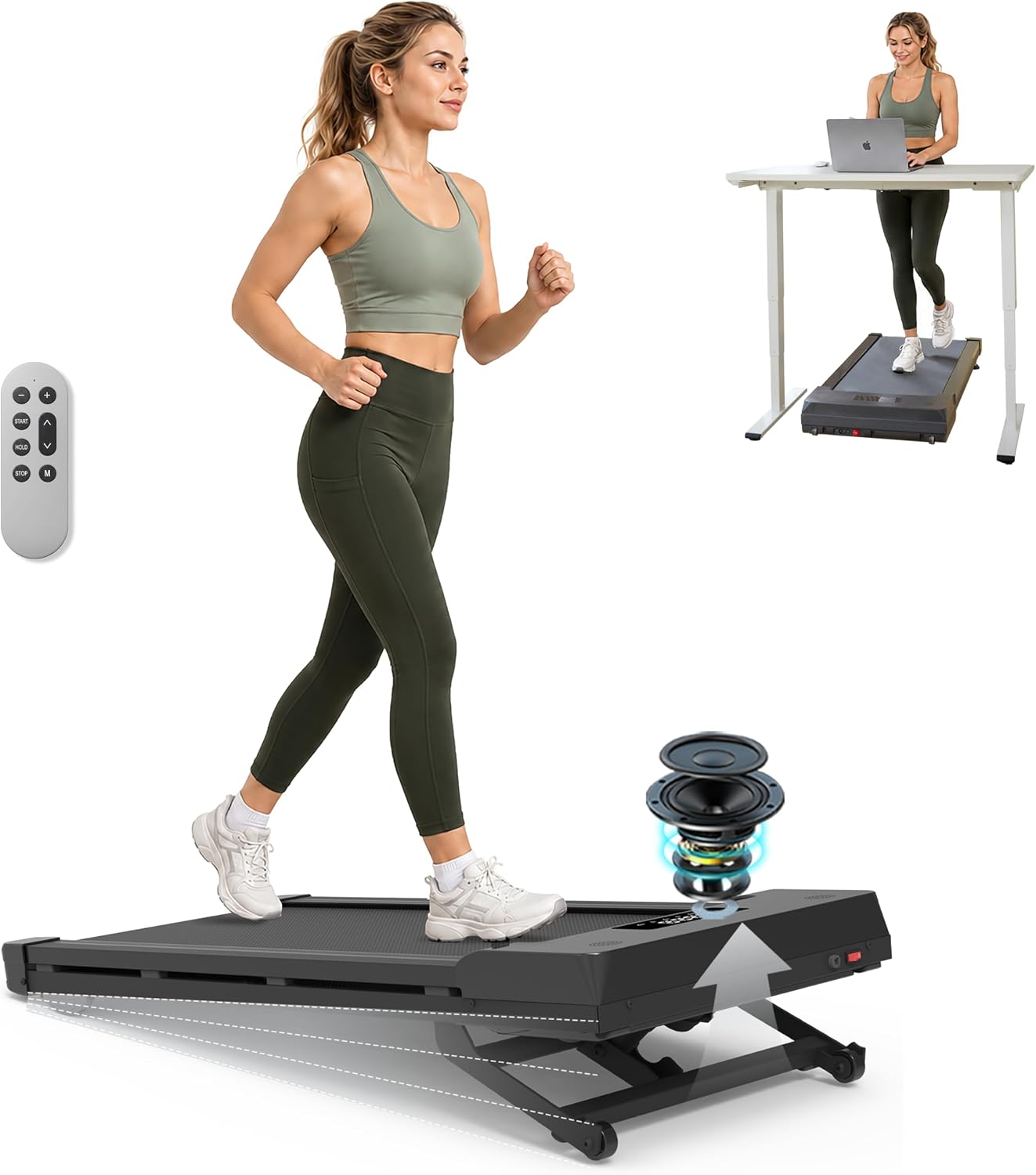
Best Overall: Walking Pad Treadmill, Auto Incline 12%
Twelve percent auto incline is the headline, and for once the headline is the feature. Incline you change from the remote, mid-walk, without stopping, is the difference between a flat belt and a hill. On a flat pad I can walk for an hour and forget I am walking. On a grade I feel it in the first ten minutes, which is the point of walking while you work rather than instead of working.
The auto part matters more than the twelve. Manual incline on a walking pad usually means stopping, stepping off, and kneeling on the floor to move a pin. Nobody does that on a Tuesday. If the grade adjusts while you keep walking, you will actually use it.
Two things I would verify before buying. First, does the incline hold at 1.5 to 2 MPH, or does it only engage at higher speeds? Desk walking happens at low speed, and a feature that only works at 4 MPH is not a desk feature. Second, what does the deck measure in the down position? Incline mechanisms add height, and a pad that will not slide under your desk is a pad that lives in the closet. The grey black finish is a small thing, but a dark deck under a dark desk disappears in a way a white one does not.
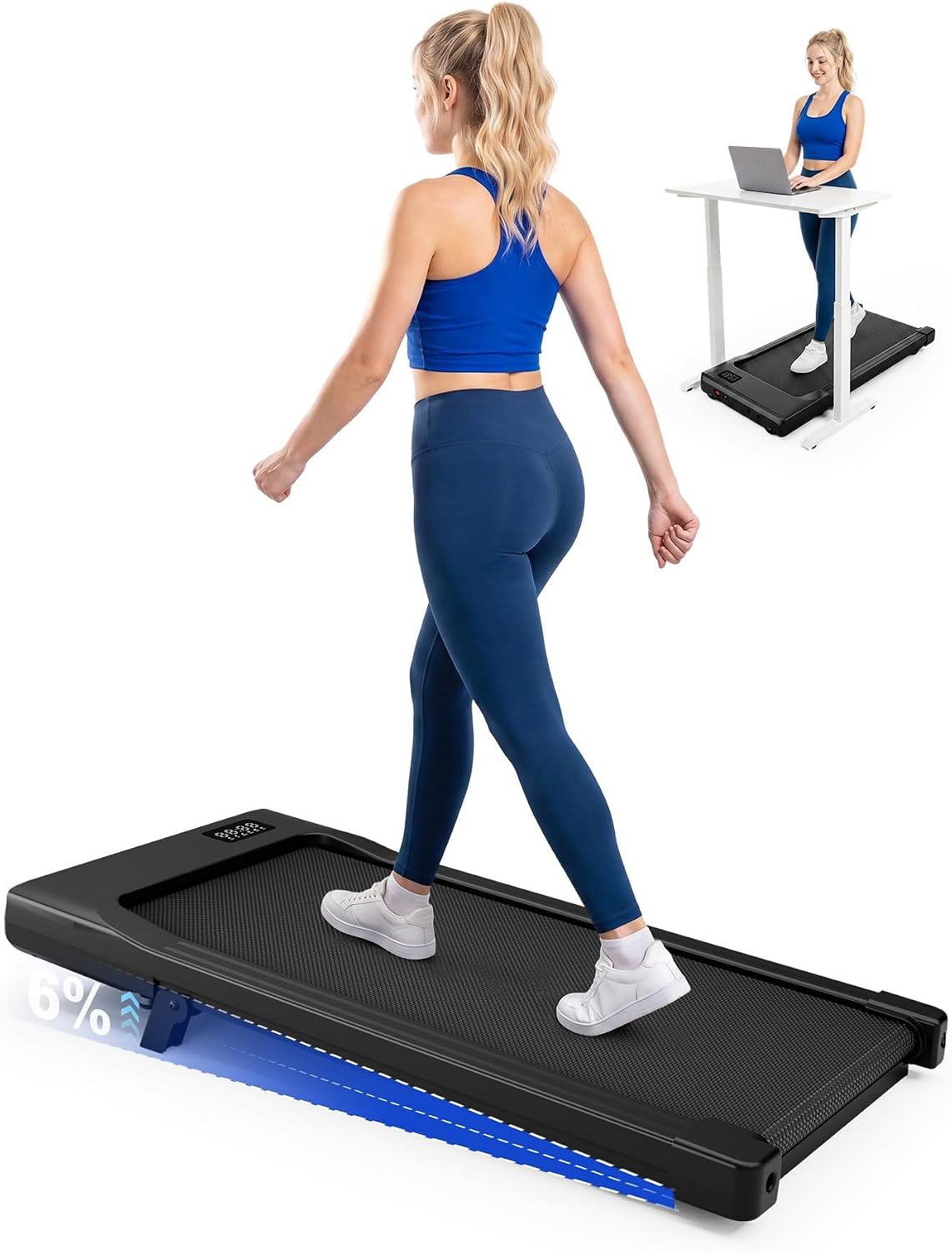
Best Value: MJWW 6% Incline Walking Pad
Six percent is the number I would pick if I were buying one pad for a full workday. It is enough to wake up your calves and raise your heart rate a little, and not so much that you spend the afternoon leaning on the desk. If you have ever walked a gym treadmill at 10% grade, you know that is a workout, not a workday.
The smart part of the name is where I get skeptical, and you should too. Intelligence in a walking pad usually means an app that counts steps and suggests speeds, and an app that requires an account to change the speed is worse than a remote with four buttons. My rule is simple: if I cannot change the speed without my phone, the phone stays in the drawer and the pad goes back in the box. Confirm that a physical remote is included and that it works from a chair without pointing.
A gentler grade is also friendlier to barefoot walking. At a hard incline your foot slides forward inside the shoe, and barefoot on a steep belt is a friction problem.
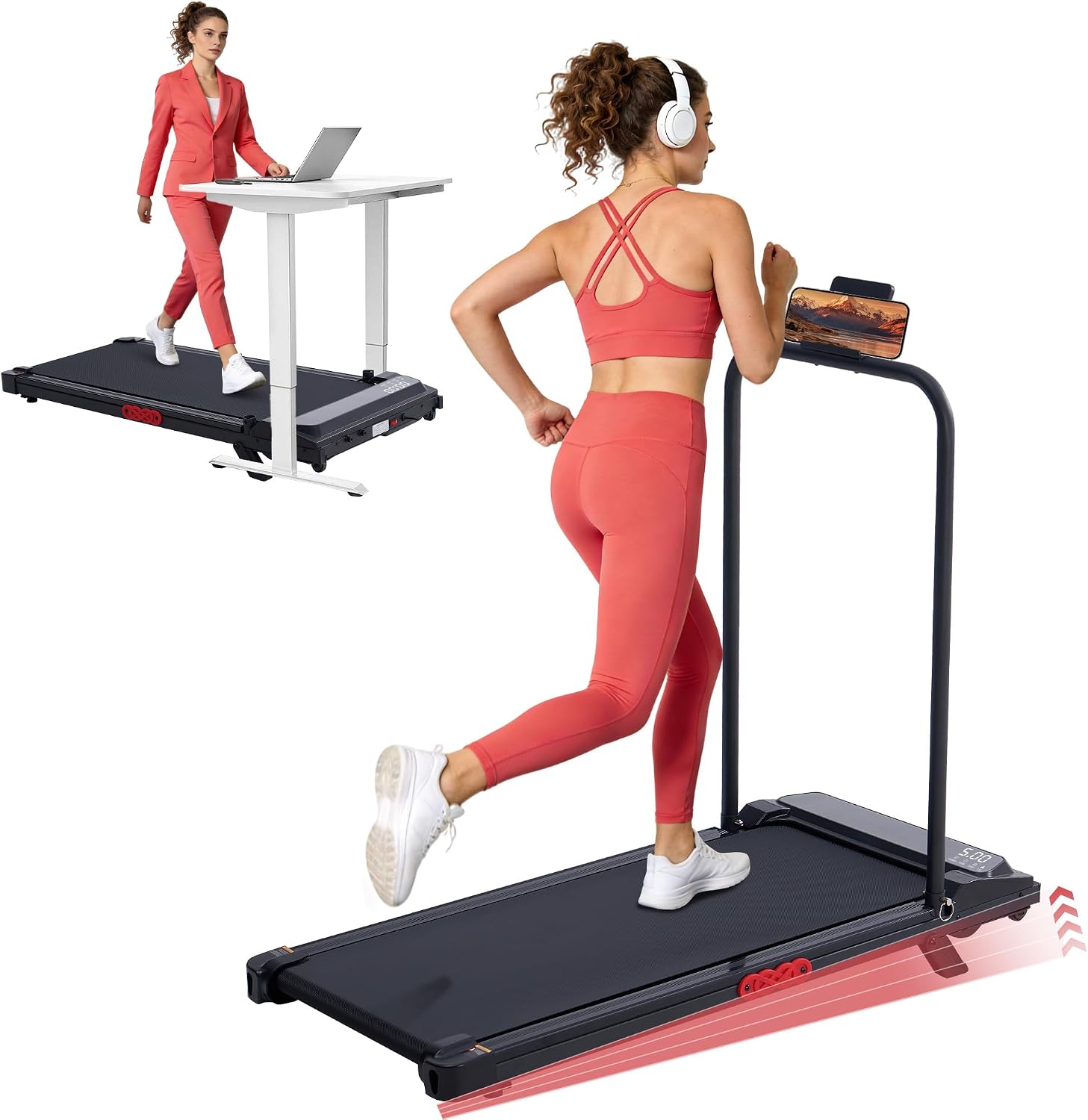
Best for Stability: MCRG Portable Walking Pad with Handle Bar
I do not review running on walking pads. The safety profile is wrong: no side rails wide enough, no emergency stop you can reach at speed, and a deck that was never built for a stride. So when a listing advertises 10 MPH, I read it as a motor spec and nothing else. I cap a walking pad at 2.5 MPH, and this one is no exception.
What I care about is everything around that number. The 3.5 HP motor is the largest on this list on paper, and the 400 pound weight rating is the more useful spec. Weight capacity is a frame tell. A company that rates a compact pad at 400 pounds is telling you the deck and the uprights are heavier than the toy-grade pads that top out around 220.
The handle bar is the other half of it. Handles give you something to grab when you turn to answer the phone, and they make the machine feel less like a loose belt on the floor. They also make it easier to fold and roll out of the way, which matters in a small apartment where the pad shares a room with a couch. If you wobble at 2.5 MPH, if you are heavier than the average listing assumes, or if one pad has to move between rooms, this is the pick.
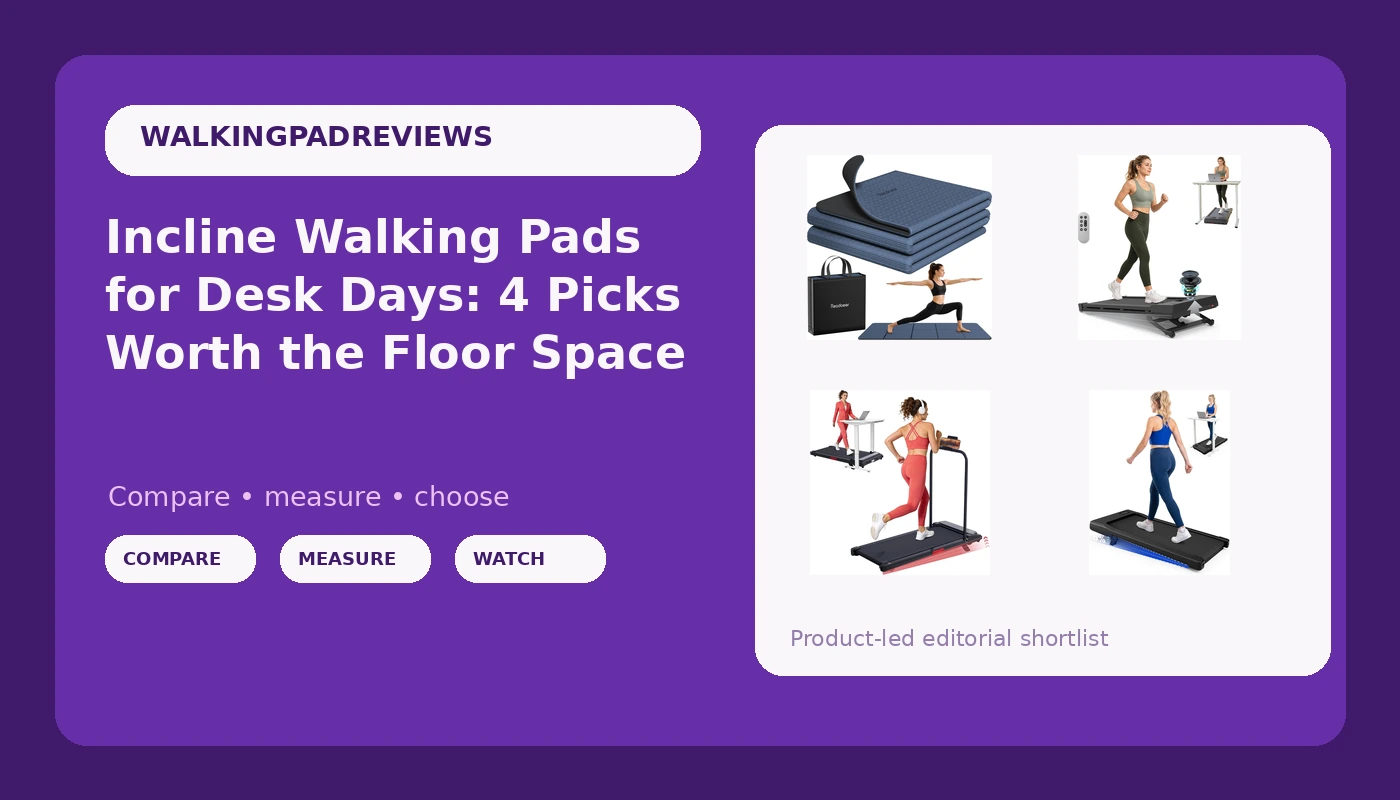
Best Accessory: Readaeer Double Color Yoga Mat
The mat is the unglamorous pick, and it solves two problems the pads create.
First, floors. A walking pad on hardwood leaves marks and sends a low hum into the room below. A 6mm mat under the pad's feet is the cheap version of a vibration fix. Second, barefoot walking. If you walk without shoes, you want a clean, non-slip surface to step onto when you step off, and 72 by 24 inches is the right size to stand on beside a desk.
One caution. TPE is closed cell, which means it does not soak up sweat and does not smell like a gym mat after a month, and that is why I would take it over a cheap PVC mat. But 6mm is thick enough to squish. If you put it under the pad's feet and feel any compression at 2.5 MPH, slide it out from under the machine and leave it beside the desk instead. A pad that rocks is a pad you stop trusting.
How I judge a walking pad
I own three pads, and I judge every new one the same way. I do not quote idle noise. Manufacturers measure decibels at idle because idle is quiet, and nobody walks at idle. I measure at ear height, standing, at 2 MPH, because that is the number that decides whether I can take a call while I walk.
Then I check the boring things. Deck height in the down position, measured against the desk I already own. Belt width, because a narrow belt means your feet drift toward the rails and you start watching your feet instead of your screen. Remote range and angle, tested from a chair, not from directly in front of the pad. Auto-stop, because a pad that keeps running when you step off is a hazard, not a convenience.
Warranty length is the last check and the one I weight heaviest. A company that trusts its motor backs it for three years. A one-year warranty on a small motor tells you what the company thinks of its own parts.
Analysis and notes
Incline is what splits this list. The MJWW's 6% is a desk feature. The auto incline pad's 12% is a training feature you can also use at a desk. Both are useful. They are not the same purchase.
Peak versus sustained horsepower is where listings stretch the truth most. A 3.5 HP figure is usually peak, a number the motor hits for a few seconds, not the number it holds for an hour. For walking at 2 MPH, sustained power matters far more than the peak on the box, and a pad that lists only peak is a pad hiding the real number.
Weight capacity is the quiet spec. A 400 pound rating is a frame statement. Pads rated at 220 pounds are often the same motor in a thinner frame, and thinner frames wobble at 2.5 MPH. If you sit near the top of a pad's weight rating, buy the next one up.
The category is also splitting. Flat pads are becoming the budget tier, incline pads the middle tier, and handle-bar machines with real weight ratings the top of the under-desk category. Buying an incline pad today means buying into the part of the market that is still getting better.
The walking pad reference table
This is the table I keep when I compare pads. Everything in it comes from the published listing specs, not from a marketing sentence. Where a listing does not publish a number, the cell says so.
| Pad | Incline | Speed and motor | Weight rating | Best for |
|---|---|---|---|---|
 Visit on Amazon → Walking Pad Treadmill, Auto Incline 12% |
12%, auto | Not listed | Not listed | Changing grade mid-walk |
 Visit on Amazon → MJWW 6% Incline Walking Pad |
6% | Not listed | Not listed | Full workdays at a desk |
 Visit on Amazon → MCRG Portable Walking Pad with Handle Bar |
Incline, with handle bar | 0.6 to 10 MPH, 3.5 HP | 400 lbs | Stability and heavier walkers |
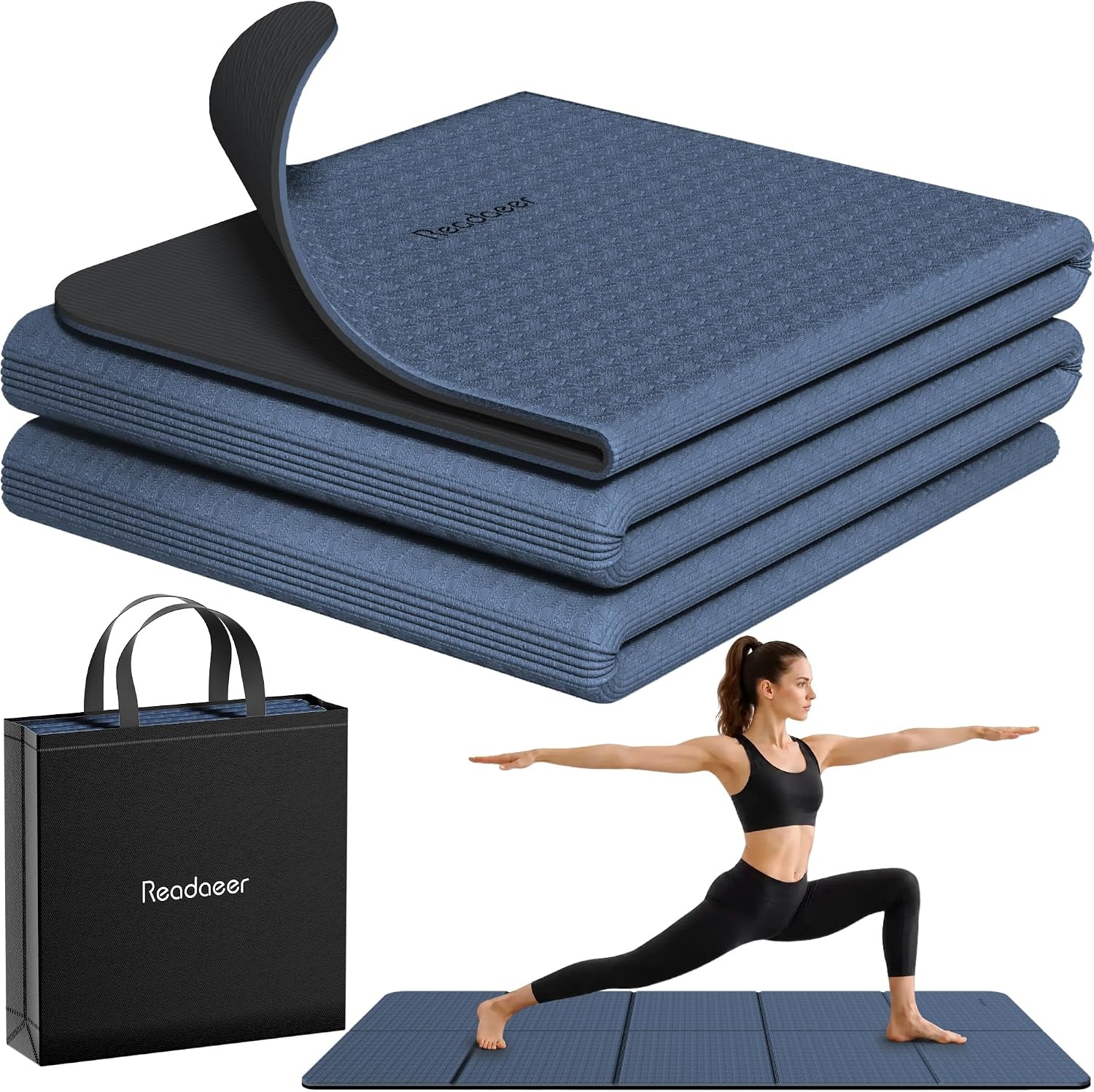 Visit on Amazon → Readaeer Double Color Yoga Mat |
Not applicable | Not applicable | Not applicable | Floor protection, barefoot standing |
Each pad above links to its own listing, where you can check current Amazon price and the warranty terms before you commit. The warranty line is the one I would read twice.
Auto incline versus fixed incline
Fixed incline means you set the grade before you start and live with it. Auto incline means you change it from the remote while walking. For a desk worker, auto is worth more than a steeper number, because the grade you can adjust in three seconds is the grade you will actually use on a Wednesday afternoon. If a pad offers 12% but only from a stopped position, treat it as a fixed incline and judge it that way.
What the mat is actually for
The mat is not a treadmill accessory in the usual sense. It is a floor protector and a standing surface. Put it under the pad's feet on hardwood, or leave it beside the desk for barefoot stretches between walking blocks. Just keep an eye on compression, because a squishy layer under a belt is how a stable pad starts to rock.
Should you buy the Walking Pad Treadmill with Auto Incline 12%?
Yes, if you want to change grade without stepping off. It is the only pad here that adjusts incline mid-walk, and the grey black deck is built for a desk footprint. Verify that the incline engages at 1.5 to 2 MPH, and measure your desk clearance before it ships. Buy it for the auto function, not for the twelve percent.
Should you buy the MJWW 6% Incline Walking Pad?
Yes, if you want a grade you can hold all day. Six percent is the sensible number for eight hours of desk walking, and it is kinder to barefoot strides than a steep belt. Check that a real remote is in the box and that speed changes do not route through an account. If the remote is line-of-sight only, that is a daily annoyance you will feel forty times over.
Should you buy the MCRG Portable Walking Pad with Handle Bar?
Yes, if stability is the thing that has kept you from buying a pad at all. The handle bar and the 400 pound rating are the two specs that matter here, and they point to a heavier frame than the toy-grade competition. Ignore the 10 MPH figure entirely. Walk it at 2 to 2.5 MPH, hold the bar when you turn, and it will do everything a desk worker needs.
Should you buy the Readaeer Double Color Yoga Mat?
Yes, as the cheap insurance policy for the rest of the setup. It protects hardwood, it muffles a little vibration, and it gives you a non-slip place to stand barefoot. At 6mm it is a floor layer, not a cushion, so keep it out from under the belt if you feel it compress. If you are buying an incline pad for a wood floor, buy the mat in the same order.