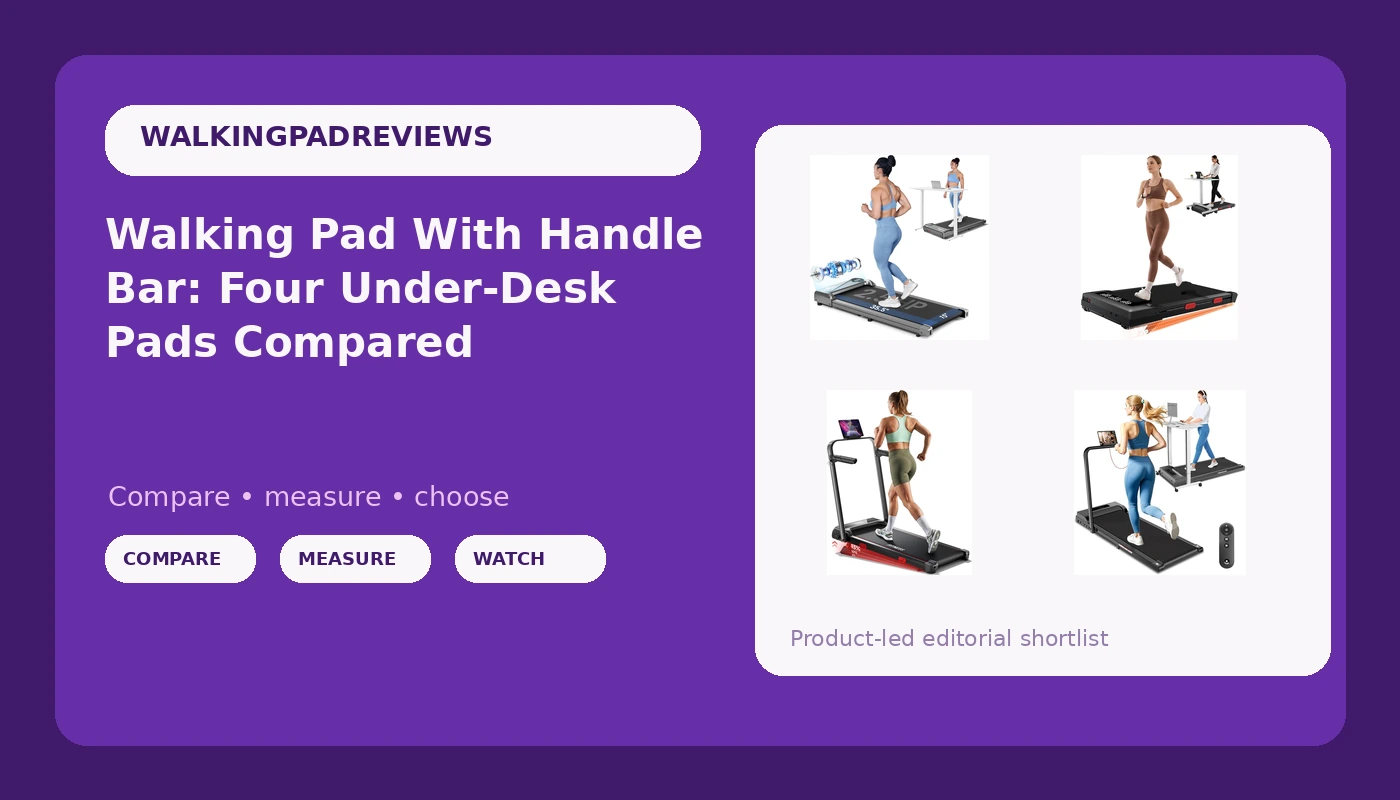
I bought my first walking pad because an L5 disc herniation at 31 ended a nine year run of ten hour sitting days, and my physical therapist handed me a plain instruction: move hourly or pay for it later. I rebuilt a home office in Austin around that instruction, and I keep a tape measure, a step counter, and a spreadsheet of decibel readings within arm's reach of the desk. A walking pad is a medical device with a marketing problem, and I review it like one. So this comparison comes down to the question most listings bury: do you want a walking pad with handle bar, or a flat deck with nothing to hold when your cadence drifts?
For most remote workers with an adjustable desk, the 3.0 HP folding pad with incline and a handle bar is where I would start, because a handhold plus a small incline is what keeps a 2 mph walk sustainable past week two instead of week two being the end. The long answer is about peak versus sustained horsepower, weight capacity that has to cover more than your body, a belt width that decides whether barefoot walking feels good, and a remote control that almost nobody tests properly. Four pads are on the table here, and they split into two camps: the flat portables, and the ones that give you something to hold.
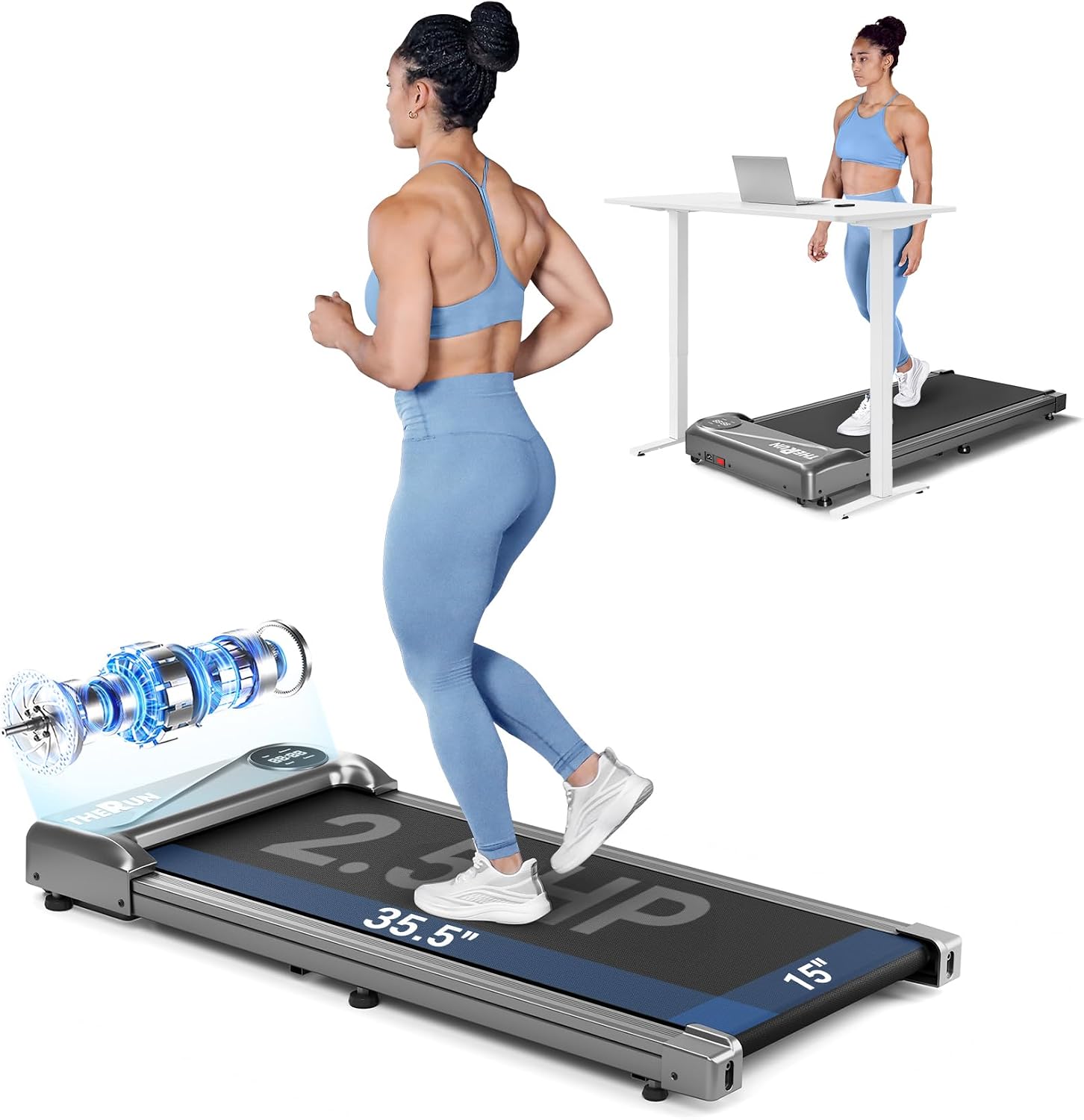
THERUN Walking Pad Treadmill Under Desk
2.5 HP motor, 265 lb capacity, remote control and LED display in a genuinely portable mini treadmill
No incline, no handle bar, so nothing to grab when you look away from the belt
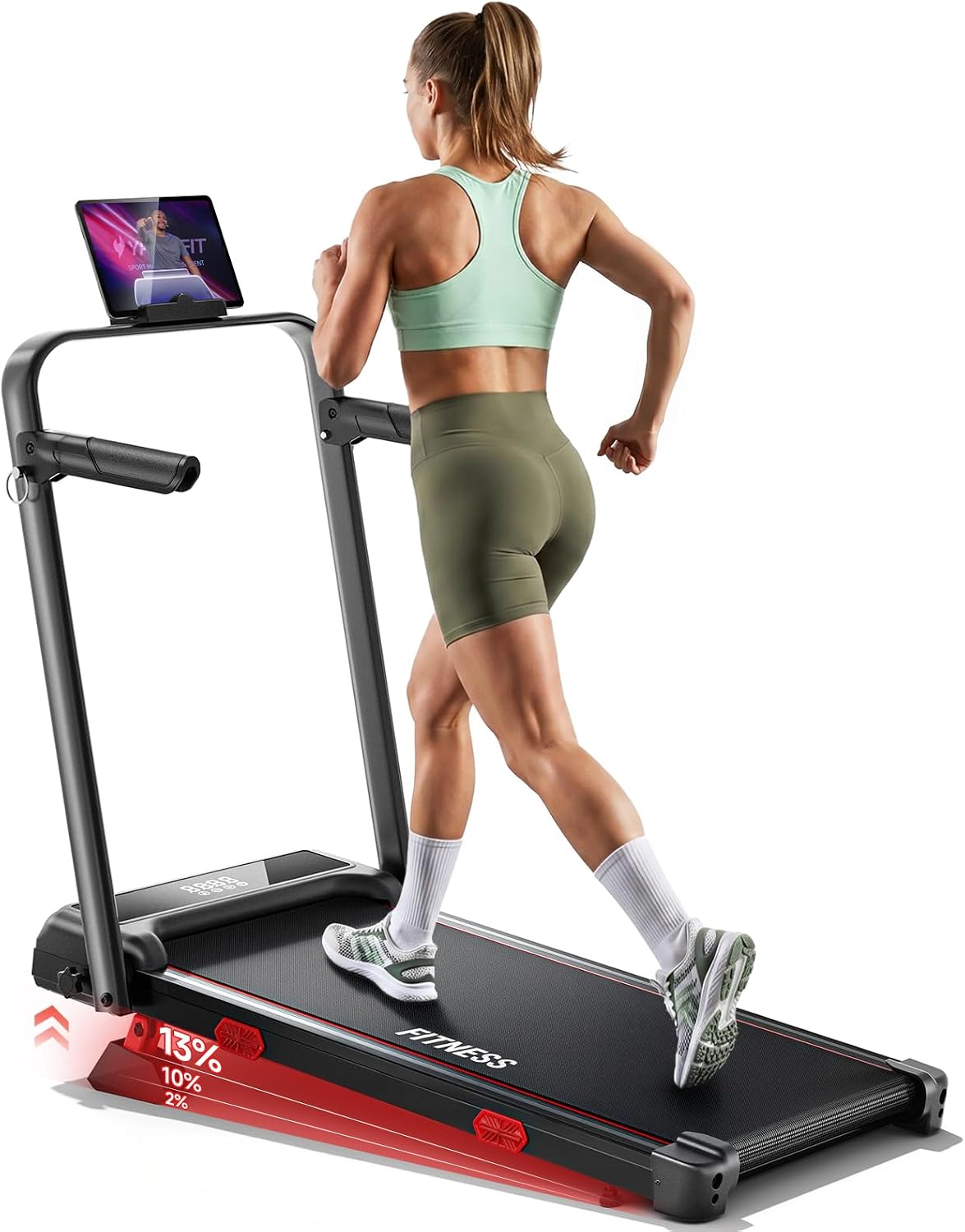
Walking Pad Treadmill with Incline, 3.0HP Quiet Motor
3.0 HP quiet motor, 300 lb capacity, incline, handle bar, and a folding frame in one package
The heaviest spec sheet here, which matters if the pad has to live under a bed
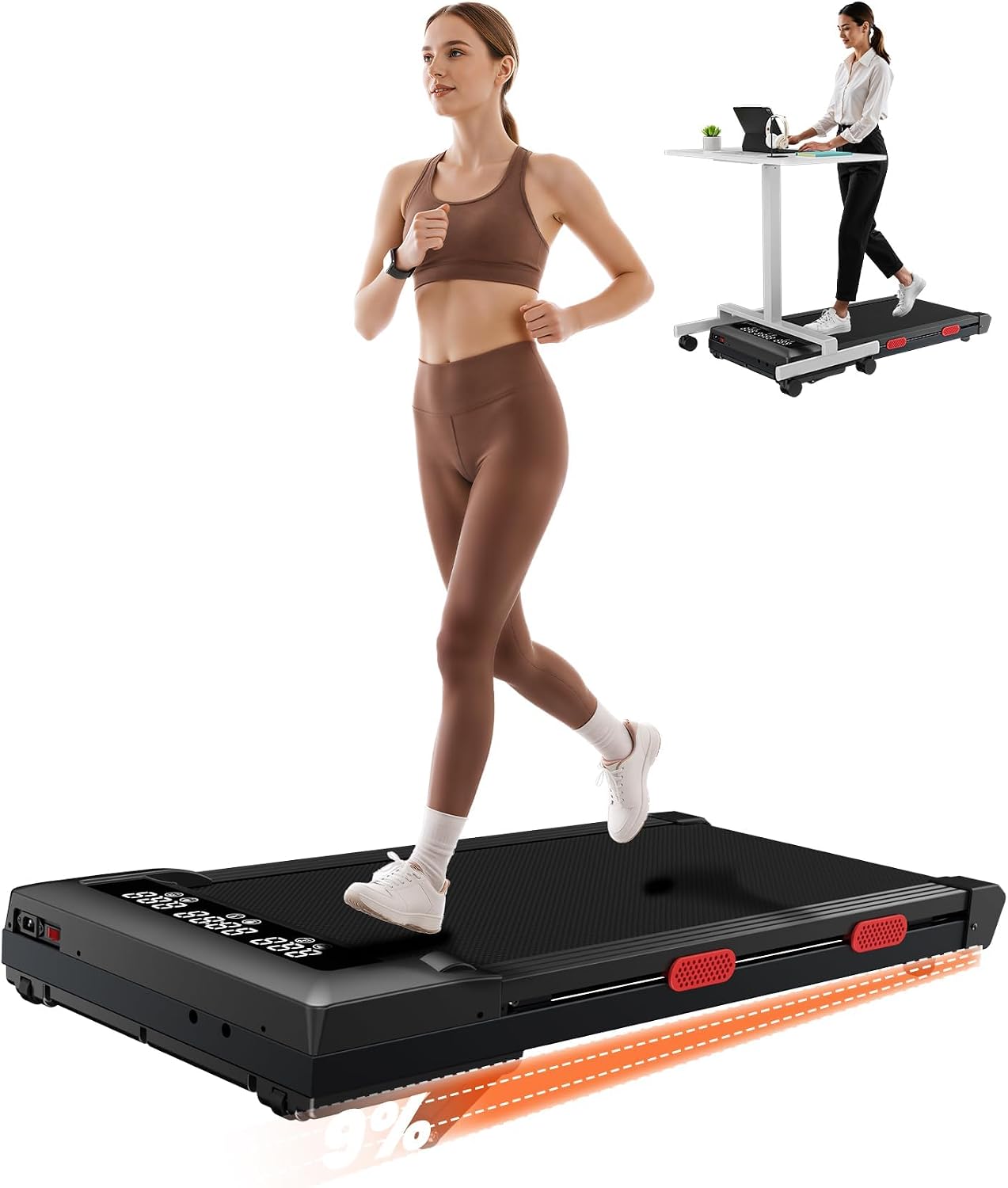
Treadmills for Home Walking Pad with Incline Handle Bar Foldable
Incline, handle bar, and a foldable deck at a mid tier position in this group
The listing publishes the least information, with no motor rating and no weight capacity stated
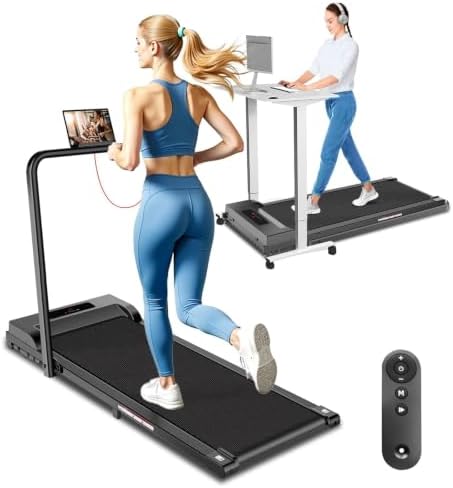
Walking Pad Treadmill for Home with Handle Bar, 3.0HP Low Noise
3.0 HP low noise motor, handle bar, remote control, LED display, 250 lb capacity
Lowest capacity of the two 3.0 HP pads, and no incline
Prices and availability were captured from Amazon Creators API and may change.
How I evaluate a walking pad
Four things get checked before price ever enters the conversation: belt width, deck height, remote behavior, and warranty length. I walk at 2 mph, because that is the speed where a pad either disappears under your attention or demands all of it, and I measure noise at ear height while walking rather than at idle. Every manufacturer quotes the idle number, and the idle number is fiction.
Under desk treadmills are not treadmills. Comparing them to gym equipment is how people get hurt, so nothing here is about running. This is a category where most pads under a certain price share the same motor and a different sticker on the side, and where the frame, the belt, and the remote are the only places quality actually shows up.
The strongest predictor of whether you will still be using a pad in six months is not the motor spec. It is whether the pad is stable enough that you stop thinking about your feet. That is why the handle bar question sits at the center of this comparison.
Why a handle bar changes the math
A handle bar is not a training accessory on a walking pad. It is a stability feature, and it changes how the whole session feels at desk speed.
When you walk at 2 mph while reading email, your eyes leave the belt for long stretches. On a flat deck with no handhold, your body compensates with small balance corrections, and those corrections show up as tension in your lower back and calves by the end of an hour. A handle bar gives you a place to put a hand when you glance at a second monitor or reach for a mug. That single point of contact is the difference between a walk you forget about and a walk you keep checking on.
There is a second benefit that matters if you walk barefoot or in socks, which I do. Barefoot walking puts more demand on your feet and ankles, and a handhold makes it easier to keep a steady cadence instead of a nervous shuffle. The three pads here with a handle bar, the 3.0 HP folding incline model, the foldable incline model, and the 3.0 HP low noise model, are all built around that idea. The THERUN Walking Pad Treadmill Under Desk is the outlier, a flat portable mini treadmill with no handhold at all.
The trade off is footprint and storage. Handle bars add height and, on some frames, mean the pad cannot slide fully under a low sofa. If your pad lives under the bed between sessions, measure the folded height before you buy anything with a bar attached.
Peak versus sustained horsepower
Motor ratings in this category need translation. A 2.5 HP or 3.0 HP figure on a walking pad listing is almost always a peak rating, the number the motor can hit briefly under load. What you actually live with is the sustained rating, and sustained output is what decides whether the belt holds a constant speed when a 200 lb walker steps on.
This matters because a belt that sags and surges under load is the single most irritating thing about cheap pads. You feel it as a hitch in your stride every few minutes, and it is the reason some people conclude that walking pads are toys.
Practically, the 3.0 HP pads in this group, the folding incline model and the low noise model with handle bar, sit a step above the 2.5 HP THERUN on paper. That gap shows up most at the top of the speed range and on incline, where the motor is doing more work. If you weigh close to a pad's capacity limit, buy more motor than you think you need.
One caveat: do not treat horsepower as a quality score on its own. A well built 2.5 HP pad with a rigid frame beats a floppy 3.0 HP pad every time. The spec is a ceiling, not a promise.
Weight capacity covers more than your body
Weight capacity is the number people misread most often. It is not just about the walker. It is about the walker plus whatever the pad is carrying in dynamic load, and about how much margin the frame was designed with.
The range here runs from 250 lb on the 3.0 HP low noise model, through 265 lb on the THERUN, up to 300 lb on the 3.0 HP folding incline pad. The foldable incline model publishes no capacity figure at all, which is the kind of omission I treat as a real warning sign rather than a formatting oversight.
My rule is to leave 25 percent of headroom. If you weigh 200 lb, a 250 lb rated pad is technically fine, but a 300 lb rated pad will run cooler, quieter, and longer. The frame will flex less at speed, and the belt will track straighter. That is not a marketing claim, it is how loaded motors behave.
Incline on a walking pad: small angle, real difference
Incline is the feature that surprised me most when I started walking full workdays. Two pads here offer it: the 3.0 HP folding incline model and the foldable incline model.
A walking pad incline is gentle compared to a gym treadmill, and that is the point. It shifts load from your shins toward your glutes and calves, and it changes your cadence in a way that keeps a 2 mph walk from feeling like standing in a slow moving queue. It also raises the front of the deck, which changes how your wrists sit on a keyboard tray.
Two pads in this group have no incline: the THERUN and the 3.0 HP low noise handle bar model. That is not a flaw. A flat deck is easier to fold, easier to store, and simpler to step onto in socks. But if your goal is NEAT rather than distance, incline is the cheapest way to make the same 30 minutes cost you more.
Noise, and why the listing number is useless
Here is the pattern I see over and over. A listing quotes a decibel figure measured at idle, with no one on the belt. Then you step on, and the belt has to move a body, and the sound changes.
Manufacturers quote dB at idle, not at walking speed. I measure at ear height while walking, and a pad that sounds silent in a showroom video is often audible on a Zoom call once it is loaded. If quiet operation is a priority, treat the phrase quiet motor as a claim to verify, not a spec.
What you can control: belt lubrication, a hard flat surface rather than carpet, and keeping the pad away from a hollow wall that amplifies vibration. The 3.0 HP low noise model in this group leads with noise as its selling point, and the folding incline model calls its motor quiet. Neither number means much until the belt is carrying a person at 2 mph.
The remote control is the most important feature nobody tests
I use my remote roughly 40 times a day. Start, stop, two clicks up, one click down, pause while I answer a question. That is the real usage pattern of a desk walker, and it is almost never reviewed.
Two failure modes show up constantly in this category. The first is line of sight remotes that need you to point them at a sensor on the deck, which is impossible when the pad is under a desk and the sensor faces the wall. The second is app control that requires an account and a login to change speed, which is absurd for a device you touch every twenty minutes.
All four pads here include a remote control, and the two 3.0 HP handle bar models and the THERUN pair it with an LED display. That is the baseline. What I want to know before buying is whether the remote works from a seated position without aiming, and whether it survives the first battery change. A dead remote turns a walking pad into a very expensive footrest.
Auto stop is the other quiet feature worth checking. Every pad should stop the belt when you step off, and you should confirm that behavior in the first week rather than assuming it.
Warranty length tells you more than the motor spec
A company that trusts its motor backs it for three years. A company that does not offers 90 days on parts and asks you to ship the unit back at your own cost.
I read warranties before I read spec sheets now, because the warranty is the manufacturer telling you its own failure rate. It also tells you how a folded frame, a belt, and a control board will be handled if something goes wrong in month eight. Check the warranty term, check who pays return shipping, and check whether the remote is covered. The remote is the part most likely to fail first, and it is the part most often excluded.
Which of these four should you buy
Buy the Walking Pad Treadmill with Incline, 3.0HP Quiet Motor if you want one pad that covers everything. Incline, handle bar, 300 lb capacity, a 3.0 HP motor, and a folding frame. It is the most complete package in this group, and the capacity margin is the reason I would pay more for it. Visit on Amazon → to check the current listing details.
Buy the Walking Pad Treadmill for Home with Handle Bar, 3.0HP Low Noise if your desk is on a shared wall or a shared call. Same motor class and same handhold, without incline, and with a 250 lb capacity that suits lighter walkers. Visit on Amazon → to confirm the capacity rating against your own weight.
Buy the Treadmills for Home Walking Pad with Incline Handle Bar Foldable only if you can verify the missing specs. Incline, handle bar, and a foldable deck are the right combination, but no motor rating and no weight capacity means you are buying on faith. Visit on Amazon → and read the listing carefully before you commit.
Buy the THERUN Walking Pad Treadmill Under Desk if the pad has to disappear. It is the flat, portable, mini treadmill option here, with a 2.5 HP motor, 265 lb capacity, remote control, and LED display. No bar, no incline, and no pretense of being anything other than a quiet way to add steps. Visit on Amazon → to see the folded dimensions.
What I would skip, and why
I would skip any pad, including the foldable incline model here, that hides its motor rating and weight capacity. Those two numbers are not marketing decoration, they are the load limits of the machine you are standing on, and a listing that omits them is asking you to guess.
I would also skip the assumption that a handle bar is only for beginners. In my experience the opposite is true. The more hours you spend walking while working, the more you appreciate having something to steady yourself with when you look away.
And I would skip running on any of these. Walking pads are not treadmills. The safety profile is different, the belt is shorter, and the frames are not built for it.
The bottom line
The category splits cleanly. Flat portables like the THERUN are storage friendly and simple. Handle bar pads with incline, led by the 3.0 HP folding model, are what make a full workday at 2 mph realistic rather than aspirational. Check current Amazon price on the ones that fit your desk, measure the space under it first, and treat the remote and the warranty as the two specs that will actually decide whether you are still walking in six months.