Most people buy a walking pad for home office use and assume the decision ends at checkout. It does not. The decision that actually matters happens in week three, when the pad is still under the desk, the remote is still within arm's reach, and the floor underneath has not started to complain. Everything before that is logistics.
The reason a walking pad for home office work is a harder purchase than it looks is that you will use it while distracted. You are not watching your feet. You are reading, typing, and taking calls. That changes the questions worth asking: how wide is the belt compared with your stride, how does the control behave when you are not looking at it, what is the machine standing on, and what happens at 2.5 mph when your attention is somewhere else entirely.
Related: Walking Pad Noise: What Decibel Ratings Actually Mean →
Quick answer
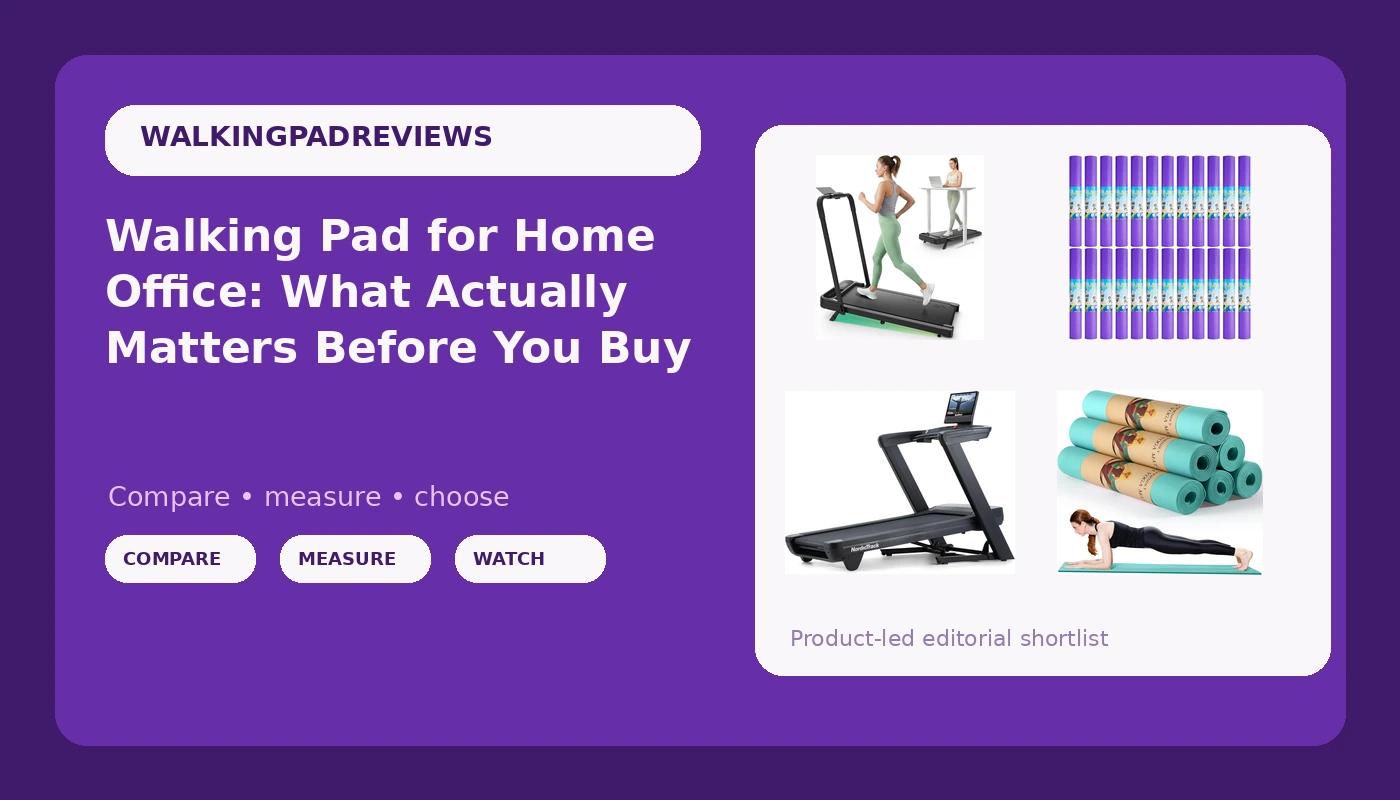
A walking pad for home office use works when three things line up: a belt wide enough for your natural stride, a control method you can operate without looking down, and a floor that is flat, protected, and free of wobble. In this group, the UREVO Strol 2E Pro is the walking pad, the NordicTrack Commercial Series is a full treadmill with a different safety profile, and the two mat packs are floor and mobility accessories rather than machines. Start with the pad, sort out what it stands on second, and treat a treadmill as a separate purchase for a separate activity.
Four useful options
| Model | Best fit | What stands out |
|---|---|---|
| UREVO Strol 2E Pro Smart Walking Pad Treadmill with APP, 12% Incline, Compact Walking Pad with Safety Handle, Plug & Play, Desk Treadmill with LED Display, Walking & Running for Home Office | Desk days and slow indoor walking | Lists a 12% incline, a safety handle, app control, and an LED display |
| NordicTrack Commercial Series Treadmills: Commercial 1250, 1750, 2450 | Running workouts away from the desk | Three models in one commercial series, built for full treadmill use |
| Timgle 6 Pack Yoga Mats Bulk 68x24 Inches Non Slip 4 mm Thick | Floor protection and post-walk mobility work | Six non slip mats at 4 mm thick, each 68 by 24 inches |
| Funtery 3 mm Thin Yoga Mats Bulk, 68 x 24 in | A thin, stable layer under a pad | 3 mm profile and a 68 by 24 inch footprint, sold in bulk |
The walking pad: UREVO Strol 2E Pro Smart Walking Pad Treadmill with APP, 12% Incline, Compact Walking Pad with Safety Handle, Plug & Play, Desk Treadmill with LED Display, Walking & Running for Home Office
The incline is the detail worth pausing on. Most pads in this class sit flat, so every step happens on a level surface and your calves do none of the extra work an incline creates. A listed 12% grade changes the effort and the posture at the same speed, which is useful if you want a walking session that feels like something. The safety handle matters most in the first week, while you are still learning where the belt edges are and how the deck reacts when you shift weight. App control and an LED display cover the two ways people actually change speed: phone in hand, or buttons under the deck.
One caution. The product name includes both walking and running, but this is still an under-desk form factor. Walking pads are not treadmills, and treating one like gym equipment at speed is how people get hurt. Keep the pace conversational, keep the handle up, and let the incline do the work the speed does not need to.
The treadmill for running: NordicTrack Commercial Series Treadmills: Commercial 1250, 1750, 2450
The Commercial Series belongs in a different conversation, and it is worth saying that plainly instead of pretending the categories are interchangeable. A full treadmill is engineered for running: a longer deck, higher sustained output, and a safety profile that assumes you might fall at speed. It also assumes a room with clearance behind it and a floor that can take the load. If your goal is a pad you step onto barefoot during calls, this is not that product. If your goal is real running plus desk walking, you are looking at two purchases rather than one, and the pad is the easier half to get right.
The mat under the pad: Timgle 6 Pack Yoga Mats Bulk 68x24 Inches Non Slip 4 mm Thick
A mat under a walking pad does two jobs: it keeps the frame from scuffing the floor, and it absorbs some of the vibration the deck sends downward. The non slip surface matters more than the thickness here, because a mat that slides under a machine is worse than no mat at all. A six pack at 4 mm gives you one for under the pad, one for the stretch you should be doing after a walk, and spares for the standing desk area. Spares are not padding: mats compress over time, and having a replacement on hand means you do not keep walking on a flattened one.
The thin mat option: Funtery 3 mm Thin Yoga Mats Bulk, 68 x 24 in
Thin mats get dismissed as the cheap option, and in this specific use case that is backwards. At 3 mm, a mat adds floor protection without adding squish. Squish is the enemy under a walking pad: a soft surface under the frame lets the deck move in ways the frame was not designed for, and that movement is what people end up blaming on the machine. If your floor is already flat and you mainly want to stop scuffs and keep the frame from creeping, the thinner mat is the more sensible layer. A bulk pack makes sense for the same reason it does in the thicker option: mats migrate, and having more than one means the pad is never sitting on bare floor while you get around to ordering another.
Prices and availability may change. Product images, names, and retailer links are matched to verified listings. No current price, rating, stock status, or measured result is stated here without current evidence.
Belt width, deck height, and why a walking pad is not a treadmill
Under-desk treadmills are not treadmills. They share a motor and a belt, and that is roughly where the similarity stops. A walking pad is built for one activity: walking at roughly 1 to 3 mph while you do something else. The frame is shorter, the deck sits lower, the belt is narrower, and the handrail, when there is one, is a balance aid rather than something you grip while sprinting.
Belt width is the specification buyers underweight most. Your feet drift outward when you walk without looking down, and a belt that is narrow for your stride turns a normal walk into a series of small corrections. The measurement that matters is not your shoe size. It is the width of your natural stride plus a margin you are comfortable with, taken while you are walking, not standing still.
Deck height matters for a different reason. A lower deck is easier to step onto and off of, which counts when you sit and stand throughout the day rather than committing to one position. A higher deck usually signals a bigger motor and a heavier frame, which is fine in a gym and less fine in a room where the pad shares floor space with a chair and a wastebasket.
Then there is the motor rating. Peak horsepower is a marketing number. Sustained output is the number that decides whether a pad holds its speed when your weight shifts. Motors in this category are modest by design, and that is acceptable for walking, which is exactly why running on one is a bad idea. The machine is not the thing being tested at that point. Your knees are.
What to check before you commit
Product pages reward the wrong questions. Incline percentage, top speed, and app features are easy to list and easy to compare. The details that decide whether you keep using the pad are quieter, and most of them are not in the spec sheet at all.
- Measure the width of your natural stride while walking, then compare it with the belt width on the listing.
- Decide whether you will control speed from a remote, a console, or an app, and check whether the app needs an account before it will change speed.
- Check what the pad will sit on. Bare floor, rug, and mat all change how stable the frame feels underfoot.
- Confirm whether anyone in the house will actually run on it. If the answer is yes, that is a treadmill purchase, not a pad purchase.
- Set a realistic daily target in minutes or steps, because NEAT accumulates in small blocks rather than one heroic session.
Setting up the space around the pad
- Put the pad on a hard, flat surface. If you want a mat, choose thin over thick so the frame stays level.
- Leave room behind the belt to step off without turning around, and keep the power cord out of the walking path.
- Match your desk height to your walking posture, not your sitting posture. A desk that is right when seated is usually too low when you are walking.
- Keep the control within reach without leaning. A control you have to hunt for is a control you stop using.
- Build the habit in short blocks. Fifteen to twenty minutes at a conversational pace, several times a day, beats one long session you start dreading.
Which option should you choose?
Choose the UREVO Strol 2E Pro Smart Walking Pad Treadmill with APP, 12% Incline, Compact Walking Pad with Safety Handle, Plug & Play, Desk Treadmill with LED Display, Walking & Running for Home Office when you want a compact pad for desk days, with a listed incline, a safety handle, and app plus display control. Choose the NordicTrack Commercial Series Treadmills: Commercial 1250, 1750, 2450 when running is the real goal and you have the space and the budget for a full treadmill. Choose the Timgle 6 Pack Yoga Mats Bulk 68x24 Inches Non Slip 4 mm Thick when you want a thicker layer for floor protection and mobility work, and choose the Funtery 3 mm Thin Yoga Mats Bulk, 68 x 24 in when you want floor protection without any squish under the frame.
None of these products is ranked against the others here, because they do different jobs and a ranking would imply otherwise. Before you buy, check the current listing for the specifications that decide your case: belt width, weight limit, folded dimensions, and warranty terms. Warranty length tells you more about a motor than the horsepower figure on the box does, and a company that backs its motor for three years is telling you something a spec sheet cannot.
The bottom line
A walking pad is a piece of furniture you walk on, and it succeeds or fails on boring details: belt width, control method, floor stability, and whether the setup survives an ordinary Tuesday. Get the pad that fits your stride and your desk, protect the floor with a thin mat rather than a soft one, and keep running on a treadmill where the safety profile belongs. The purchase is the easy part. The week three test is the one that counts.